
Assembly adhesive vs. drilling – which fastening method is the better choice?
Posted on Apr 19, 2026
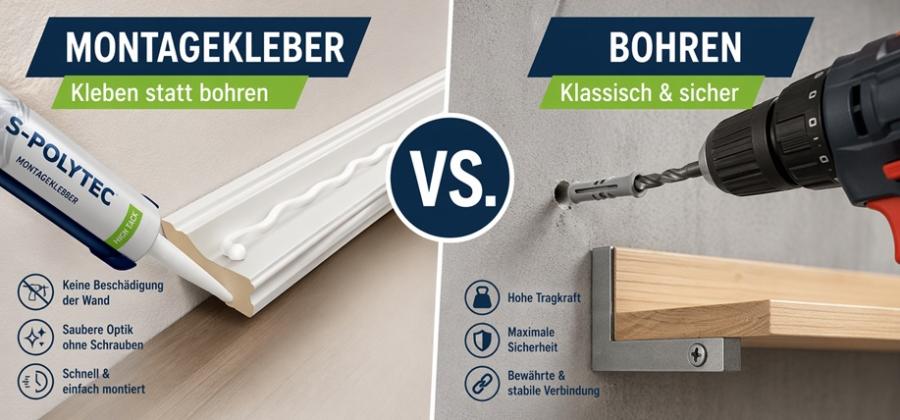
Assembly adhesive or drilling? Choosing the right fastening method affects durability, appearance and effort – we show when bonding is the better solution and when screws are the better choice.
Bonding or drilling? For many installation tasks, both fastening methods are now available. Modern assembly adhesives enable concealed joints without visible screws, while drilling and screwing are particularly advantageous for high loads and safety-relevant fastenings.
In this blog, we compare both methods directly and show when bonding makes sense, when a mechanical fastening is the better choice and in which cases both methods can be combined.
Assembly adhesive – fastening without drilling
Assembly adhesives enable concealed fastening without screw or plug heads on the visible surface. This can be a decisive advantage particularly for decorative components, cladding and sensitive surfaces.
- No visible fasteners: Screw or plug heads do not appear on the visible surface.
- No fastening holes: The component being installed does not necessarily have to be drilled through for fastening.
- Clean appearance: Particularly suitable for cladding and decorative elements.
- Distributed load transfer: Loads can be distributed across several beads or bonding areas.
- Different materials: Suitable adhesives can join different materials together.
You can find suitable assembly adhesives directly from S-Polytec.
Important: An adhesive bond is only as reliable as the substrate, adhesive and preparation. Load-bearing capacity, material compatibility and intended use must suit the specific project.
Drilling and screwing – mechanical fastening
Mechanical fastenings using screws, plugs or other connecting elements are particularly suitable when high loads must be transferred or clearly defined mechanical securing is required.
- Direct mechanical connection: The load is transferred through the screw, plug or fastening system.
- Immediately loadable: There is no need to wait for an adhesive to cure.
- Easy to control: The type and number of fastening points can be planned precisely.
- Removal possible: Many screw connections can be loosened again later.
- Suitable for high loads: With a suitable substrate and correctly designed fastening, high loads can be accommodated.
Typical applications: Shelves, wall cabinets, TV mounts, load-bearing structures and other components where mechanical fastening is structurally required.
Assembly adhesive or drilling – a direct comparison
| Criterion | Assembly adhesive | Drilling & screwing |
|---|---|---|
| Visible fastening | Generally not visible | May be visible depending on the fastening |
| Drill holes | Not required | Generally required |
| Load capacity | Depends on adhesive, area and substrate | Depends on screw, plug and substrate |
| Load capacity after installation | Allow for curing time | Generally immediate |
| Substrate | Must be sound, clean and suitable for bonding | Must be suitable for the selected fastening system |
| Removal | May be more difficult depending on the adhesive | Usually easier with removable connections |
| Appearance | Very suitable for concealed fastening | Fastening points may remain visible |
Decisive factor: Neither bonding nor drilling is inherently better. The right fastening method depends on the load, substrate, material, application and desired appearance.
When is bonding suitable?
- Concealed fastening: Screws or plugs should be avoided on the visible surface.
- Decorative components: Trim, panels, cladding or other design elements are being installed.
- Avoid drilling: The component or substrate should not be drilled unnecessarily.
- Large contact area: The joint can be made over a sufficiently large bonding area.
- Suitable substrate: The surface is sound, clean and compatible with the adhesive used.
Rental property: Bonding does not automatically mean damage-free removal. Depending on the adhesive and substrate, coatings, wallpaper or other surfaces can be damaged during later removal.
When are drilling and screwing suitable?
- High loads: Heavy components must be held reliably.
- Safety-relevant installation: The fastening must be clearly definable from a structural perspective.
- Immediate loading: A curing time is not practical.
- Removal required: The component should be easy to remove again later.
- Unsuitable bonding surface: The substrate does not provide reliable conditions for bonding.
Examples: Wall cabinets, heavy shelves, wall brackets and load-bearing components should be installed using a fastening system suitable for the load and substrate.
Combining bonding and screws
In certain constructions, adhesive and mechanical fastening can be used together. The two joining methods perform different functions.
| Fastening | Possible function |
|---|---|
| Adhesive | Surface bonding, gap compensation or additional fixing |
| Screws | Mechanical securing and direct load transfer |
Do not combine indiscriminately: Additional bonding does not automatically make an unsuitable screw connection safer. Likewise, a single screw does not replace a correctly designed adhesive joint. For structural applications, the entire fastening concept must be coordinated.
Common mistakes when choosing between bonding and drilling
- Deciding only by weight: Leverage, substrate and fastening area also influence the load.
- Not checking the substrate: Loose coatings or unsuitable building materials can impair both fastening methods.
- Choosing the wrong adhesive: Not every assembly adhesive is suitable for every material and application.
- Using the wrong plugs: Plugs and screws must suit the relevant wall or building material.
- Ignoring curing time: Bonded components must not be fully loaded too early.
- Underestimating removal: Adhesive joints can be considerably more difficult to remove later than screw connections.
Assembly adhesive or drilling: the key points summarised
Bonding is particularly suitable for concealed fastenings, decorative components and applications with a sufficiently sound bonding surface. A prerequisite is always an adhesive that suits the material and substrate.
Drilling and screwing remain the suitable solution especially for high loads, safety-relevant components and constructions with a defined mechanical fastening.
The decisive question is therefore not which method is generally better, but which fastening method is technically and practically appropriate for the specific application.
Frequently asked questions about bonding or drilling
Which is better: bonding or drilling?
It depends on the application. Bonding is particularly suitable for concealed fastenings and suitable surface joints. Drilling and screwing offer advantages for high loads, immediate load capacity and removable connections.
Can assembly adhesive replace drilling?
For suitable applications, assembly adhesive can replace a mechanical fastening. Whether this is possible depends on the component, load, bonding area, substrate and adhesive used.
How much weight can assembly adhesive hold?
A general weight figure is not meaningful. Load capacity depends on factors including the adhesive, bonding area, substrate, load direction and environmental conditions.
Is bonding better than drilling in a rental property?
Bonding avoids drill holes, but it is not automatically residue-free. Depending on the substrate and adhesive, wallpaper, paint or other surfaces may be damaged during removal.
Can heavy components be fastened with assembly adhesive?
This is only possible if the adhesive, bonding area, substrate and load are designed for it. For heavy or safety-relevant components, suitable mechanical fastening is often the safer or required solution.
Can bonding and screwing be combined?
Yes, both methods can be combined in suitable constructions. Adhesive and mechanical fastening should form part of a coordinated fastening concept.
What requirements must the substrate meet for bonding?
The bonding surface should be sound, clean and compatible with the adhesive used. Dust, grease, loose coatings and other residues that reduce adhesion must be removed before installation.
Category Usage tips
- Aluminium composite panel installation guide: fastening, applications & tips for indoors and outdoors
- Aluminium construction profiles: applications, planning and accessories
- Assembly adhesive applications and processing - tips for strong bonds
- Avoid root damage by using root barriers
- Bonding acrylic glass – adhesives, preparation and instructions