
Aluminium composite panel installation guide: fastening, applications & tips for indoors and outdoors
Posted on May 13, 2026
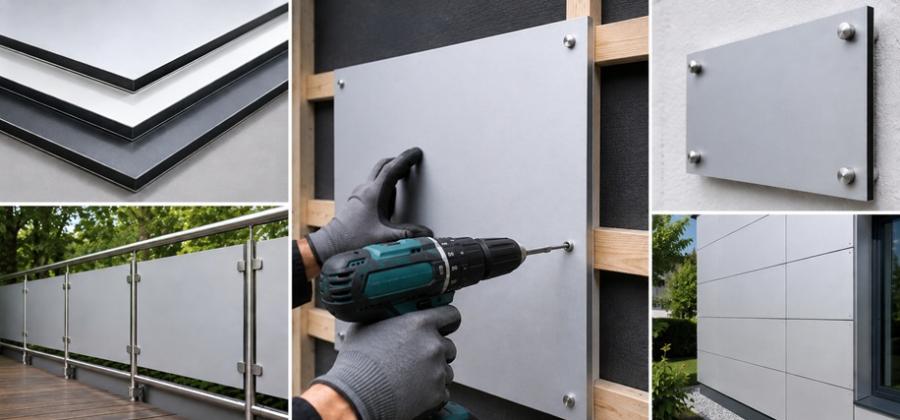
Aluminium composite panels can be installed in many ways and are suitable, among other things, as balcony privacy screens, facade cladding, wall signs or modern interior cladding. In this installation guide, we show the most important fastening methods, suitable substrates and practical tips for clean and durable installation indoors and outdoors.
Installing aluminium composite panels is possible in different ways: depending on the application, they can be screwed, bonded, riveted, fastened with spacers or guided in suitable profiles. Which installation method is appropriate depends mainly on the substrate, panel size, application and load.
In this blog, we provide a complete overview of installing aluminium composite panels. You will learn which fastening methods are suitable for different applications, which tools are required and what to consider regarding preparation, drilling, substrates, outdoor installation and material movement.
Installing aluminium composite panels: quick overview
The appropriate installation method depends on the specific application. Small signs or interior cladding have different requirements from balcony cladding or large facade elements.
| Application | Typical installation method | Particularly important |
|---|---|---|
| Wall sign / company sign | Spacers, screws or bonding | Alignment, substrate and even drilling pattern |
| Interior wall cladding | Bonding, screws or profiles | Flat and clean substrate |
| Kitchen splashback | Bonding or screws | Substrate, cleaning and temperature range |
| Balcony cladding | Mechanical fastening or suitable profile system | Wind load, railing construction and material movement |
| Facade cladding | Rivets, screws or suitable profiles on substructure | Substructure, rear ventilation, joints and thermal movement |
| Outdoor advertising sign | Screws, spacers or frame | Wind load and corrosion-resistant fasteners |
Important: Especially for large outdoor surfaces, the installation method must not be selected based on appearance alone. Panel format, substructure, fastening points and occurring loads must be considered together.
Which fastening methods are available for aluminium composite panels?
Aluminium composite panels can be fastened mechanically or with adhesive. The following overview helps select the appropriate method.
| Installation method | Typical application | Special feature |
|---|---|---|
| Screws | Signs, wall and balcony cladding | Removable mechanical connection |
| Bonding | Interior cladding, kitchen splashbacks and signs | No visible screw heads |
| Rivets | Metal substructures and facades | Permanent mechanical fastening |
| Spacers | Company, practice and information signs | Visible wall spacing and premium appearance |
| Aluminium profiles | Wall cladding, facades and interior construction | Clean edges, transitions and joints |
Selection guide: Bonding can be useful for discreet indoor installation. If the panel needs to be removed later, screw mounting is often suitable. For large facade panels on metal substructures, rivet mounting with fixed and sliding points can be appropriate.
Tools and mounting materials
The tools required depend on the selected fastening method and substrate.
Basic equipment
- Measuring and marking: Tape measure, folding rule, pencil or suitable marking pen.
- Alignment: Spirit level or laser.
- Drilling and screwing: Drill or cordless screwdriver and suitable drill bits.
- Panel drilling: Suitable sharp metal drill bit.
- Substrate: Wood, metal or masonry drill bits to suit the building material.
- Finishing: Suitable deburring tool or other tool for removing sharp burrs.
Additionally depending on installation method
| Installation method | Additionally required |
|---|---|
| Screws | Suitable screws, washers and, if necessary, wall plugs |
| Bonding | Suitable assembly adhesive, cleaner and, if necessary, mounting tape for initial fixing |
| Rivets | Facade rivets, compatible riveting tool and, depending on the system, special gauge mouthpiece |
| Spacers | Spacers, screws and wall plugs suitable for the wall material |
| Facade | Suitable substructure, fasteners and, if necessary, finishing or connecting profiles |
Prepare aluminium composite panel installation correctly
Clean preparation reduces installation errors and makes later panel alignment easier.
- Check dimensions: Check panel size, joints, edge distances, profiles and adjacent components before installation.
- Check the substrate: It must be sufficiently load-bearing, clean and suitable for the selected installation method.
- Plan fastening points: Position drill holes evenly and with sufficient distance from the panel edges.
- Allow for material movement: For outdoor applications, allow for thermal expansion in the drilling pattern and fastening.
- Check the visible side: Before drilling and cutting, check which side of the panel will later be visible.
- Keep protective film: Leave the film on the surface as long as possible during processing and installation and remove it only where it interferes.
Planning: A simple sketch with panel dimensions, joints, fastening points and substructure makes installation much easier, especially with several panels.
Screw aluminium composite panels
Screw mounting is versatile and, depending on the substrate, suitable for numerous indoor and outdoor applications. Suitable fasteners, clean drill holes and fastening that does not unnecessarily stress the panel are important.
- Mark drilling points precisely.
- Pre-drill the aluminium composite panel cleanly.
- Deburr the drill-hole edges.
- Prepare the substrate to suit the fastening system.
- Align the panel precisely.
- Tighten screws in a controlled manner without visibly pulling in the surface.
For outdoor applications, suitable facade screws for aluminium composite panels are available.
Detailed guide: Screw selection, drill holes, edge distances and different substrates are explained in detail in our separate blog about screwing aluminium composite panels.
Bond aluminium composite panels
Adhesive installation is particularly suitable when no visible fasteners are desired. A suitable, sufficiently load-bearing substrate and an adhesive intended for the panel, substrate and application are required.
- Check substrate: Ensure load-bearing capacity and material compatibility.
- Prepare surfaces: Clean and prepare bonding surfaces according to the adhesive manufacturer's instructions.
- Apply adhesive: Carry out application and layer thickness according to the adhesive system used.
- Align the panel: Check position and joint pattern before final pressing.
- Observe curing: Secure the panel against slipping until sufficient initial or final strength is reached.
Suitable assembly adhesive is available in the S-Polytec range.
Detailed guide: We explain substrate preparation, suitable adhesives and processing in the blog Bonding aluminium composite panels.
Important: For large, heavily loaded or highly wind-exposed outdoor surfaces, adhesive-only installation must not be assumed to be suitable as a general rule. The adhesive system used and the entire construction must be designed for the application.
Rivet aluminium composite panels
Facade rivets are used in particular for aluminium composite panels on suitable metal substructures. For large outdoor applications, temperature-related material movement is especially important.
- Mechanical connection: Permanent connection of panel and substructure.
- Fixed point: Defines the position of the panel.
- Sliding points: Allow the required thermal movement.
- Centring: The rivet must be correctly positioned in the larger sliding hole.
- Gap: The rivet head must not rigidly clamp an intended sliding point.
Detailed guide: Facade rivets, drill diameters, fixed and sliding points and the special ALU-16 gauge mouthpiece are explained in our separate blog about riveting aluminium composite panels.
Install aluminium composite panels with spacers
Spacers are often used for signs when the panel should stand visibly away from the wall. This creates a clean and premium appearance.
| Suitable application | Installation note |
|---|---|
| Company signs | Arrange spacers symmetrically and with a uniform edge distance. |
| Practice signs | Match the wall fastening to the existing substrate. |
| Door and information signs | Match panel size and number of holders. |
| Advertising signs | For outdoor installation, allow for additional wind loads. |
Suitable stainless steel spacers and clamps are available directly from S-Polytec.
Aluminium profiles for aluminium composite panels
Profiles can cover open panel edges, connect several panels or create clean internal and external corners. Especially with visible wall and facade cladding, they support a uniform joint pattern.
| Profile type | Typical function |
|---|---|
| U-profile | Finish and protection of visible panel edges |
| H-profile | Connection of two adjacent panels |
| Internal corner profile | Clean transition at internal corners |
| External corner profile | Finish and transition at external corners |
S-Polytec offers suitable aluminium U-, H-, internal-corner and external-corner profiles for aluminium composite panels.
Install aluminium composite panels by application
Depending on the application, the requirements for fastening and substructure vary considerably.
Balcony privacy screen
For balcony cladding, wind load is particularly important in addition to a clean appearance. Large closed surfaces can transfer considerable forces to the railing and fasteners.
- Check the railing and fastening options in advance.
- Divide panels sensibly into fields or segments.
- Arrange fastening points evenly.
- Use corrosion-resistant fasteners.
- Allow for thermal material movement.
- Check structural, tenancy or ownership requirements.
Suitable panels for balcony cladding and privacy screens are available in the corresponding category.
Wall sign and company sign
Depending on the desired appearance, screws, spacers, adhesive installation or frame profiles are suitable for company, practice and information signs.
- Direct screw mounting: Simple mechanical installation.
- Spacers: Premium wall spacing with visible fastening.
- Bonding: Suitable when visible fastening should be avoided and the substrate suits the adhesive system.
- Profiles: Can visually frame edges and transitions.
Facade cladding
For facades, aluminium composite panels are often installed on a suitable substructure. Joints, material movement, rear ventilation and fastening must be planned as an overall system.
- Take the load-bearing capacity of substrate and substructure into account.
- Define panel format and joint pattern before installation.
- Allow for thermal expansion.
- Use suitable fasteners.
- Plan necessary rear ventilation and structural moisture protection.
- Take wind loads and other structural requirements into account.
Interior applications
Indoors, aluminium composite panels are used, among other things, as wall cladding, kitchen splashbacks, furniture fronts or shopfitting elements. Depending on the substrate, bonding, screws, spacers and profiles can be particularly suitable.
Install aluminium composite panels on wood, metal, masonry and concrete
The existing substrate largely determines which fastening system can be used.
| Substrate | Possible fastening | What to consider |
|---|---|---|
| Wood | Suitable wood or facade screws | Wood quality, moisture and sufficient load-bearing capacity |
| Metal | Screws, through-bolted connections or rivets | Pre-drilling, material compatibility and corrosion protection |
| Masonry | Suitable screws and wall plugs | Type and load-bearing capacity of masonry |
| Concrete | Suitable anchor or screw systems | Select fastening to suit the existing concrete |
Uneven substrates: For larger unevenness, an aligned substructure may be more appropriate than direct panel installation.
Drilling, cutting and preparing edges
Clean processing makes installation easier and improves the final appearance.
- Drilling: Use a suitable sharp metal drill bit and support the panel securely.
- Deburr drill holes: Remove sharp edges and loose swarf after drilling.
- Cutting: Use suitable tools and a saw blade that matches the panel.
- Check edges: Deburr visible cut edges if necessary or finish with profiles.
- Protective film: Keep the surface protected as much as possible during processing.
Aluminium composite panels can also be ordered directly as aluminium composite panels cut to size.
Install aluminium composite panels outdoors
Panels installed outdoors are exposed not only to fastening loads but also to temperature changes, moisture and, depending on the installation situation, wind loads.
- Suitable panel design: The product used must be suitable for the intended outdoor application.
- Corrosion-resistant fastening: Match screws, rivets and holders to the environmental conditions.
- Material movement: Temperature-related expansion must not be blocked by rigid fastening.
- Substructure: For larger surfaces, make it sufficiently load-bearing and accurately aligned.
- Joints: Allow the necessary movement space between panels and adjacent components.
- Wind: Fasten large closed panel surfaces according to the expected load.
You can estimate the temperature-related change in length of different sheet materials with our thermal-expansion calculator.
Important: For facades, balcony cladding or other safety-relevant constructions, general installation instructions do not replace project-specific technical planning.
Common mistakes when installing aluminium composite panels
- Unsuitable fastening method: The installation method does not suit the substrate, application or load.
- Insufficient movement allowance: Temperature-related expansion is not sufficiently considered for outdoor installation.
- Screws tightened too firmly: The surface can be pulled in or the panel unnecessarily stressed.
- Unsuitable adhesive: Material, substrate or application do not suit the product used.
- Too few fastening points: Larger panels in particular may then be held insufficiently.
- Drill holes not deburred: Sharp burrs can impair installation and material movement.
- Uneven substructure: Fastening can cause stresses and visible deformation.
- Protective film left on permanently: The protective film is intended for transport and processing and should be removed after installation.
Care and cleaning after installation
Aluminium composite panels are comparatively easy to maintain in everyday use. Suitable cleaning, however, also depends on the surface, coating and any printing or film.
- Use a soft cloth or soft sponge.
- Use mild cleaning agents suitable for the surface.
- Avoid highly abrasive cleaning agents and abrasive sponges.
- Then remove cleaning agent completely with clear water.
- Treat printed or film-covered surfaces particularly gently.
Installing aluminium composite panels: the key points summarised
Depending on the application, aluminium composite panels can be screwed, bonded, riveted, fastened with spacers or installed using suitable aluminium profiles. The decisive factor is that the installation method, substrate and load are compatible.
Indoors, appearance and a flat substrate are often the main focus. Outdoor applications additionally require consideration of material movement, moisture, wind loads and a suitable substructure.
For detailed planning, our separate blogs provide comprehensive instructions for screwing, bonding and riveting.
Suitable aluminium composite panels cut to size are available directly from S-Polytec.
Frequently asked questions about installing aluminium composite panels
How can aluminium composite panels be fastened?
Depending on the application, aluminium composite panels can be screwed, bonded, riveted, fastened with spacers or installed in suitable profiles. Which method is appropriate depends on the substrate, panel size, application and load.
Do aluminium composite panels need to be pre-drilled?
For screw and rivet installation, fastening points in the aluminium composite panel are usually pre-drilled. This allows the drill position and diameter to be matched to the respective fastening system.
Can aluminium composite panels be bonded?
Yes. A suitable adhesive and a substrate that is sufficiently load-bearing and suitable for the adhesive system are required. For heavily loaded outdoor applications, the suitability of the entire adhesive joint must be checked.
Which screws are suitable for aluminium composite panels?
The appropriate screw depends mainly on the substrate and application. Suitable corrosion-resistant fasteners are required for outdoor applications.
Can aluminium composite panels be installed outdoors?
Suitable aluminium composite panels can be used for numerous outdoor applications. Fastening, substructure, thermal movement and occurring wind loads must all be taken into account.
Can aluminium composite panels be fastened to wood?
Yes. On a suitable timber substructure, aluminium composite panels can, for example, be fastened with appropriate wood or facade screws. Wood quality, moisture and load-bearing capacity must suit the construction.
How do you fasten a sign made from aluminium composite panel?
Depending on the substrate and desired appearance, signs can be screwed directly, fastened with spacers, bonded or installed in a suitable frame or profile system.
Why must movement allowance be considered for outdoor installation?
Aluminium composite panels change dimensions with temperature changes. If this movement is prevented by fastening that is too rigid, stresses and deformation can occur.
Category Usage tips
- Aluminium construction profiles: applications, planning and accessories
- Assembly adhesive applications and processing - tips for strong bonds
- Assembly adhesive vs. drilling – which fastening method is the better choice?
- Avoid root damage by using root barriers
- Bonding acrylic glass – adhesives, preparation and instructions