
Bonding aluminium composite panels – the best adhesive recommendation
Posted on Apr 19, 2026
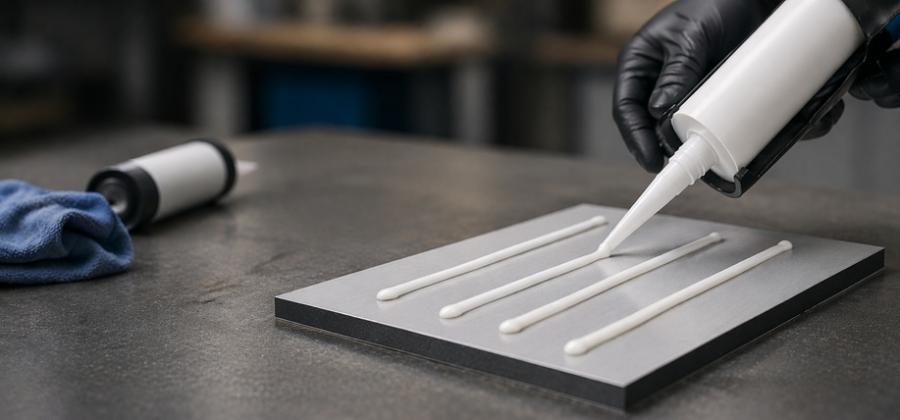
Aluminium composite panels can be joined quickly, cleanly and permanently with the right adhesive – often even better than by drilling or screwing.
Bonding aluminium composite panels enables concealed fastening without visible screws or rivets. Particularly for wall cladding, signs and other design applications, adhesive installation can therefore be an interesting alternative to mechanical fastening.
In this blog, we show which types of adhesive are suitable for aluminium composite panels, what to consider with coated surfaces and different substrates, and how to prepare, bond and fix the panels step by step during curing.
Bond aluminium composite panels instead of screwing them?
An adhesive joint can be useful wherever a clean surface without visible fastening points is desired. Unlike screws or rivets, no fastening holes need to be made in the panel.
- No visible fasteners: Screw or rivet heads do not appear on the visible surface.
- No drill holes: The panel does not need to be drilled through for fastening.
- Distributed load transfer: Loads can be distributed across several adhesive beads or bonding areas.
- Clean appearance: Especially with wall cladding and design applications, the result is a calm, uninterrupted visible surface.
- Simple installation: Depending on the application, drilling and additional visible fasteners can be avoided.
Important: Bonding is not automatically the better fastening method for every construction. Substrate, panel size, load, temperature, indoor or outdoor use and the adhesive must all be compatible.
Suitable aluminium composite panels are available from S-Polytec in various designs and cut-to-size formats.
What matters when bonding aluminium composite panels
With an aluminium composite panel, it is not the inner panel core that is bonded but the respective surface. The existing coating is therefore particularly important in determining which adhesive can be used and how the surface must be prepared.
Many aluminium composite panels have coated aluminium cover layers. The adhesive used must therefore be suitable both for the panel surface and the relevant mating material.
- Check the panel surface: Consider the coating and manufacturer information.
- Take the substrate into account: Metal, wood, mineral surfaces and plastics have different requirements.
- Allow for elasticity: Temperature-related movement between panel and substrate must not create unacceptable stresses.
- Prepare bonding surfaces: Remove dust, grease, release agents and other residues that reduce adhesion.
- Observe adhesive approval: Check the intended use and material compatibility according to the manufacturer’s information.
Basic rule: The term “aluminium composite panel” alone does not determine the adhesive choice. The actual surface to be bonded and the substrate are decisive.
Which adhesives are suitable for aluminium composite panels?
Different adhesive systems can be used for aluminium composite panels. Elastic assembly adhesives are used for many installation and cladding tasks, while high-strength two-component systems are more commonly intended for special structural applications.
| Adhesive | Properties | Typical application |
|---|---|---|
| MS polymer assembly adhesive | Elastic, easy to apply and available for numerous materials | Wall cladding, signs and general installation work |
| 2C structural adhesive | High strength and, depending on the system, gap-filling properties | More technically demanding or structural bonding applications |
Note: Whether an adhesive can be used without primer depends on the specific adhesive, panel coating and substrate. The adhesive manufacturer’s information is therefore always decisive.
MS polymer as an assembly adhesive for aluminium composite panels
For many typical installation tasks involving aluminium composite panels, a suitable MS polymer adhesive is a practical solution. The elastic adhesive joint can accommodate different material movements while also enabling concealed fastening.
- Elastic joint: Movement between panel and substrate can be accommodated better than with rigid adhesive systems.
- Versatile application: Suitable products adhere to numerous coated and mineral surfaces.
- Indoor and outdoor use: Suitable adhesives are available for outdoor applications.
- Easy application: Assembly adhesives are applied directly from cartridges or foil packs.
You can find a suitable assembly adhesive directly at S-Polytec. The existing range also includes, for example, MS polymer in grey.
Prepare the substrate for bonding
Reliable bonding starts with preparing the bonding surfaces. Contamination or unsuitable surfaces can significantly impair adhesion.
- Clean the surfaces: Completely remove dust, grease and loose residues.
- Check the substrate: The surface must be sound and suitable for bonding.
- Choose the cleaning agent carefully: Use only products that do not attack the surface or coating.
- Dry the bonding surface: Before applying the adhesive, there must be no disruptive moisture or cleaning-agent residues.
- Follow the manufacturer’s instructions: If primer or additional pre-treatment is required, proceed accordingly.
Tip: For unknown surfaces or particularly demanding applications, it is advisable to carry out an adhesion test beforehand in an inconspicuous area or on a material offcut.
Bond aluminium composite panels correctly step by step
The exact application depends on the adhesive used. The basic procedure can be divided into a few steps:
- 1. Prepare bonding surfaces: Prepare the panel and substrate so they are clean, dry and free from residues that reduce adhesion.
- 2. Apply adhesive: Apply the adhesive to the substrate or panel according to the specified bonding pattern.
- 3. Position the panel: Place the aluminium composite panel and align it precisely before final pressing.
- 4. Press evenly: Position the panel so that the intended adhesive joint is maintained.
- 5. Fix the panel: If necessary, secure it against slipping during initial adhesion.
- 6. Allow to cure: Observe the curing time specified by the adhesive manufacturer.
Do not simply spread over the entire surface: The appropriate bonding pattern and required amount of adhesive depend on the product used and the construction. Elastic assembly adhesives are often applied in beads. The respective application instructions remain decisive.
Typical applications for bonded aluminium composite panels
- Wall cladding: For clean visible surfaces without visible screws or rivets.
- Signs and displays: Concealed fastening to suitable supporting surfaces.
- Interior finishing: Decorative panel surfaces on walls and structures.
- Shopfitting and exhibition stands: Clean surfaces for presentation and design elements.
- Exterior cladding: With a suitable panel, suitable adhesive and professionally planned construction.
Common mistakes when bonding aluminium composite panels
- Using an unsuitable adhesive: Always match the adhesive to the panel surface, substrate and intended use.
- Not cleaning bonding surfaces: Grease, dust or release agents can significantly weaken the bond.
- Automatically omitting primer: Whether pre-treatment is necessary depends on the adhesive system used.
- Loading the panel too early: Full strength is only reached after sufficient curing.
- Ignoring material movement: With larger surfaces, temperature changes and different materials must be taken into account.
- Compressing the adhesive joint: An intended elastic adhesive layer must not be completely squeezed out during installation.
Bonding aluminium composite panels: the key points summarised
Bonding aluminium composite panels is particularly attractive when concealed fastening and a clean visible surface are desired. For a reliable joint, however, the adhesive, panel surface and substrate must be coordinated.
Suitable MS polymer assembly adhesives provide a practical combination of adhesion and elasticity for many typical applications. For more demanding structural requirements, other adhesive systems or additional mechanical fasteners may be necessary.
Careful substrate preparation, an application pattern suitable for the adhesive and sufficient fixing and curing times are decisive.
Frequently asked questions about bonding aluminium composite panels
Can aluminium composite panels be bonded?
Yes. Aluminium composite panels can be bonded with an adhesive suitable for the respective surface and substrate. Particularly for decorative cladding, this enables fastening without visible screws or rivets.
Which adhesive is suitable for aluminium composite panels?
Suitable MS polymer assembly adhesives can be used for many installation applications. Other adhesive systems may also be necessary for special structural requirements.
Does the surface need to be cleaned before bonding?
Yes. The bonding surfaces should be clean, dry and free from grease, dust and other residues that reduce adhesion.
Is a primer required when bonding aluminium composite panels?
That depends on the adhesive used, the panel coating and the substrate. Whether a primer is required should therefore be checked against the application instructions for the relevant adhesive system.
Can aluminium composite panels be bonded outdoors?
This is possible with a suitable panel, an adhesive suitable for outdoor use and a professionally planned construction. Weather, temperature changes and structural loads must be taken into account.
Should assembly adhesive be applied over the entire surface?
Not as a general rule. The required bonding pattern depends on the adhesive used and the specific application. Elastic assembly adhesives are often applied in beads.
How long must a bonded aluminium composite panel be fixed in place?
The required fixing time depends on the adhesive used, the adhesive joint and the environmental conditions. The manufacturer’s respective information on initial adhesion and full curing is decisive.
Category Usage tips
- Aluminium composite panel installation guide: fastening, applications & tips for indoors and outdoors
- Aluminium construction profiles: applications, planning and accessories
- Assembly adhesive applications and processing - tips for strong bonds
- Assembly adhesive vs. drilling – which fastening method is the better choice?
- Avoid root damage by using root barriers