
Riveting aluminium composite panels – facade rivets, sliding points and special nosepiece explained
Posted on May 17, 2026
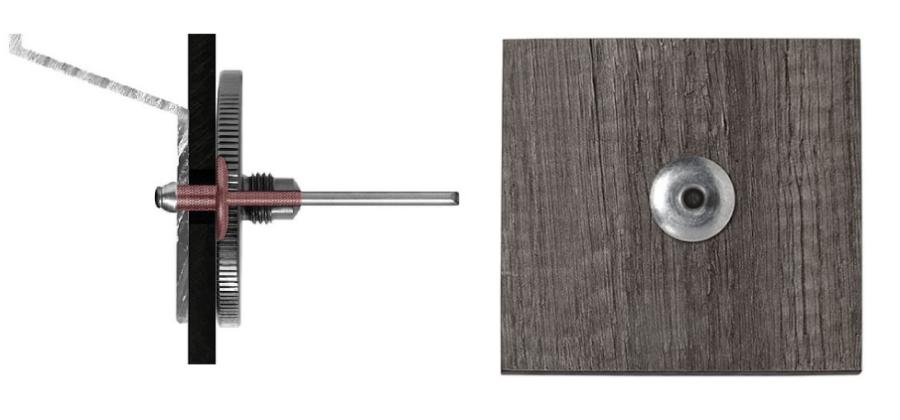
Aluminium composite panels can be fastened permanently, cleanly and without stress to substructures using facade rivets, making them ideal for modern facade and wall cladding outdoors.
Riveting aluminium composite panels is a proven fastening method for facades, wall cladding and other large-format applications on a suitable aluminium substructure. It is essential that the panels are not rigidly fixed, but that temperature-related material movement is accommodated using fixed and sliding points.
In this blog, we show which facade rivets are suitable for aluminium composite panels, how fixed and sliding points are designed and what function a special gauge nosepiece performs during rivet installation. We also explain the installation step by step and show what to consider regarding drill holes, riveting tools and low-stress fastening.
Why rivet aluminium composite panels?
Rivet installation is particularly suitable for large-format aluminium composite panels on an aluminium substructure. Facade rivets provide a permanent mechanical connection and, when installed correctly, can simultaneously accommodate the necessary material movement of the panel.
- Mechanical fastening: The panel is permanently connected to the substructure.
- Suitable for outdoor applications: Facade rivets are often used for facade and wall cladding.
- Clean joint pattern: Evenly positioned rivets create a visually calm surface.
- Large-format panels: Larger panel fields can also be installed using multiple fastening points.
- Material movement possible: Fixed and sliding points can accommodate thermal expansion of the panel.
Important: Rivet installation alone does not automatically make a facade construction suitable for a particular wind load. Panel format, substructure, fastening distances, edge distances and anchoring must suit the respective load.
Which facade rivets are suitable for aluminium composite panels?
Special facade rivets with a large rivet head are used for aluminium composite panels. The aluminium facade rivets offered by S-Polytec have a large head for broad contact with the panel surface.
| Feature | Design |
|---|---|
| Rivet material | Aluminium |
| Head diameter | 16 mm |
| Shaft diameter | 5 mm |
| Installation principle | Fixed and sliding-point installation |
| Typical use | Aluminium composite panels on suitable substructure |
Suitable facade rivets for aluminium composite panels are available directly from S-Polytec.
Note: Rivet length and specific design must suit the panel thickness and the respective substructure.
Fixed and sliding points for aluminium composite panels
Aluminium composite panels change dimensions with temperature changes. If a large-format panel is rigidly fixed at all fastening points, material movement can be restricted. This can cause stresses and visible deformation.
With fixed and sliding-point installation, one defined fixed point positions the panel. The remaining fastenings are designed as sliding points and allow the required material movement.
| Fastening point | Hole in the aluminium composite panel | Hole in the substructure | Function |
|---|---|---|---|
| Fixed point | 5.1 mm | 5.1 mm | Defines the position of the panel. |
| Sliding point | 8 mm or 10 mm | 5.1 mm | Provides movement allowance during temperature changes. |
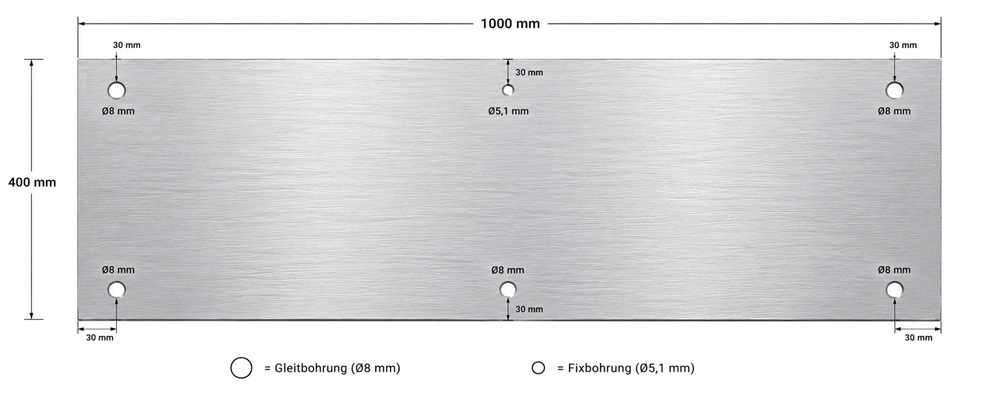
Important: The required sliding-point diameter depends, among other things, on panel size, temperature range and fastening system. A single standard hole diameter is therefore not automatically sufficient for every construction.
You can roughly calculate how much aluminium composite panels and other sheet materials expand with temperature changes using our thermal-expansion calculator.
Special gauge nosepiece ALU-16 for sliding-point installation
At sliding points, the rivet head must not clamp the panel so tightly that the necessary material movement is blocked. The ALU-16 special gauge nosepiece can be used for this purpose.
The nosepiece is intended for installing aluminium composite panels with 16 mm aluminium facade rivets and creates a defined gap between the rivet head and panel surface when setting sliding points.
| Property | ALU-16 |
|---|---|
| Use | Sliding-point installation of aluminium composite panels |
| Matching rivet head | 16 mm |
| Gap | approx. 0.3 mm |
| Thread connection | M10 |
| Function | Prevents the rivet head from being pressed too firmly against the sliding point. |
- Defined gap: The rivet head is not pressed completely against the panel at the sliding point.
- Material movement: The panel can move within the sliding hole.
- Large contact area: The nosepiece rests flat against the panel surface.
- M10 connection: Can be used with appropriately compatible riveting tools.
Suitable facade rivets and mounting materials can be selected directly to suit the planned construction.
Rivet aluminium composite panels step by step
1. Prepare the substructure
The substructure must be load-bearing, level and accurately aligned. Aluminium profiles, for example, can be used as the substructure for corresponding facade and cladding systems.
Panel position, joint pattern and fastening points should be defined before drilling begins.
2. Create fixed and sliding holes
- Fixed point: The hole in the panel and substructure is made at 5.1 mm.
- Sliding points: The hole in the aluminium composite panel is made at 8 mm or 10 mm.
- Substructure: The hole remains at 5.1 mm to suit the rivet shaft.
- Alignment: The rivet shaft should be cleanly centred within the larger sliding hole.
Practical note: The larger hole in the panel preserves movement allowance at the sliding point, while the hole in the substructure is made to match the rivet shaft.
3. Deburr the holes
After drilling, burrs and swarf should be completely removed. Clean hole edges make installation easier and prevent sharp burrs from affecting the panel surface or the movement area of the sliding point.
4. Align the panel and set the fixed point
The panel is first aligned precisely on the substructure. The defined fixed point is then riveted. It determines the fixed starting position of the panel.
Important: Additional fixed fastening points should only be provided if this corresponds to the respective installation system. Otherwise, the necessary thermal movement of the panel can be restricted.
5. Prepare sliding points
All intended sliding points must be aligned so that the rivet shaft sits as centrally as possible within the larger panel hole. Only then is the intended movement allowance available evenly.
6. Fit the special gauge nosepiece
The ALU-16 is fitted to the compatible riveting tool and positioned so that the rivet mandrel is guided cleanly through the nosepiece and its contact surface rests fully on the panel surface.
7. Rivet the sliding points
The rivet is then set. The special gauge nosepiece limits the pressure of the rivet head so that the intended gap to the panel surface is maintained at the sliding point.
Why is the gap important when riveting?
A sliding point only works if the aluminium composite panel can actually move relative to the rivet. If the rivet head is pulled too tightly against the surface, rigid clamping can occur despite the larger hole.
| Design | Effect |
|---|---|
| Rivet head too tight | The panel can be clamped at the fastening point and its change in length restricted. |
| Defined gap | The panel has movement allowance relative to the fastening element. |
| Rivet not centred | The available movement path within the sliding hole is reduced on one side. |
ALU-16: When setting sliding points, the special gauge nosepiece creates a defined gap of approx. 0.3 mm between the rivet head and panel surface.
Which riveting tools are suitable for the ALU-16?
What matters is not only whether the riveting tool is manual, electric or pneumatic. The tool must technically suit the facade rivet being used and have a compatible M10 threaded connection for the special gauge nosepiece.
| Riveting tool | Suitability |
|---|---|
| Hand riveter | Suitable with matching M10 connection and sufficient riveting capacity. |
| Electric riveting tool | Suitable provided the nosepiece mount and rivet size are compatible. |
| Pneumatic riveting tool | Suitable with an appropriately compatible M10 connection. |
Note: Before use, check whether the connection, rivet diameter and pulling capacity of the riveting tool suit the fastening system being used.
Which materials is the special gauge nosepiece suitable for?
The ALU-16 is intended for the described sliding-point installation of aluminium composite panels. What matters is not only the material name, but also that the panel construction, rivet and installation system are compatible with one another.
| Material group | Classification |
|---|---|
| Aluminium composite panels | Intended application of the ALU-16. |
| Comparable aluminium composite materials | Use only if construction and installation requirements suit the system. |
| HPL panels | Not intended for this special gauge nosepiece. |
| Fibre cement panels | Not intended for this special gauge nosepiece. |
| Solid plastic sheets | Not intended for this special gauge nosepiece. |
Common mistakes when riveting aluminium composite panels
- Making all fastening points rigid: This can restrict the necessary temperature-related material movement.
- Not centring the sliding hole: This leaves less room in the direction of movement.
- Pressing the rivet head too firmly: The sliding point can lose its function as a result.
- Not deburring holes: Burrs can affect the surface and movement area.
- Not aligning the substructure: Unevenness can introduce stresses into the cladding.
- Using a dirty nosepiece: Particles on the contact surface can press into the thin aluminium cover layer.
- Using unsuitable rivets: Rivet diameter, head shape and length must suit the fastening system.
Protect the surface: The contact surface of the special gauge nosepiece should be clean and undamaged. Dirt or damage can leave visible marks in the thin aluminium cover layer.
Riveting aluminium composite panels: the key points summarised
When riveting aluminium composite panels, it is not only the facade rivet used that matters. What is decisive is the interaction of a cleanly aligned substructure, a defined fixed point, sufficiently dimensioned sliding points and fastening that does not block thermal material movement.
The ALU-16 special gauge nosepiece supports sliding-point installation by creating a defined gap between the rivet head and panel surface when setting the facade rivet.
Suitable facade rivets and mounting materials for aluminium composite panels are available from S-Polytec.
Frequently asked questions about riveting aluminium composite panels
Which rivets are suitable for aluminium composite panels?
For suitable facade and cladding applications, aluminium facade rivets with a large rivet head are used. In the system described here, the rivets have a 5 mm shaft and a 16 mm head.
What is the difference between a fixed point and a sliding point?
The fixed point positions the panel clearly. The sliding points have larger holes in the panel and thereby allow the necessary material movement during temperature changes.
How large should the sliding hole be in aluminium composite panels?
In the installation system described here, sliding holes of 8 mm or 10 mm are used in the aluminium composite panel. The actual required size must suit the panel size, temperature load and respective installation specification.
What is a special gauge nosepiece needed for?
The special gauge nosepiece is used at sliding points. It prevents the rivet head from being pulled completely against the panel and thereby preserves the intended movement allowance.
How large is the gap created by the ALU-16 special gauge nosepiece?
The ALU-16 creates a defined gap of approximately 0.3 mm between the rivet head and panel surface.
Does the ALU-16 fit every riveting tool?
No. The riveting tool must have an M10 threaded connection that matches the special gauge nosepiece and must also be suitable for the facade rivet being used.
Why must aluminium composite panels not be fastened completely rigidly?
Aluminium composite panels change dimensions with temperature changes. If this movement is completely prevented by the fastening, stresses and deformation can occur.
Category Usage tips
- Aluminium composite panel installation guide: fastening, applications & tips for indoors and outdoors
- Aluminium construction profiles: applications, planning and accessories
- Assembly adhesive applications and processing - tips for strong bonds
- Assembly adhesive vs. drilling – which fastening method is the better choice?
- Avoid root damage by using root barriers