
Sealant for outdoors – the right protection for durable sealing
Posted on Apr 19, 2026
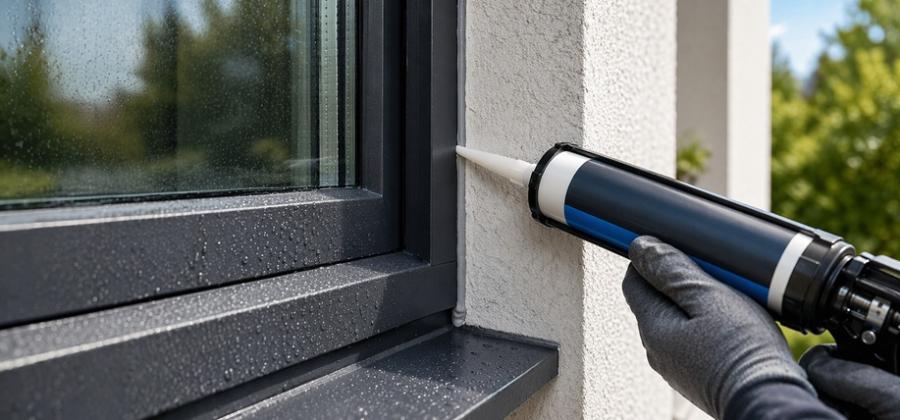
Sealants for outdoor use must withstand UV radiation, weather and temperature fluctuations – find out which sealant provides reliable long-term sealing.
Sealants for outdoor use must cope permanently with rain, UV radiation, temperature fluctuations and movement between building components. The decisive factor is therefore not only the type of sealant, but whether the specific product is suitable for the substrate, joint and exposure.
In this blog, we show which types of sealant are suitable for outdoor use, how silicone, PU and MS polymer differ and what you should pay particular attention to when selecting the product, preparing the substrate and applying it.
What must an outdoor sealant be able to do?
Exterior joints are exposed simultaneously to weather, temperature and movement of adjacent building components. A suitable sealant therefore has to do considerably more than simply close a joint visually.
| Exposure | Effect on the joint |
|---|---|
| UV radiation | Can cause unsuitable materials to age or become brittle. |
| Temperature changes | Building components expand and contract again. |
| Rain and moisture | The joint must be permanently suitable for the intended moisture exposure. |
| Component movement | The sealant must be able to accommodate movement within its permitted deformation range. |
- Weather-resistant: The sealant must be approved for the intended outdoor use.
- Sufficiently elastic: Movement of adjacent building components must be accommodated.
- Suitable for the substrate: Adhesion must be appropriate for metal, plastic, glass, concrete or other materials.
- UV-resistant: Particularly important for permanently visible joints exposed directly to the weather.
An overview of suitable products can be found in the Adhesives and sealants category.
Which sealants are suitable for outdoor use?
Commonly used sealant systems include silicone, polyurethane and modern hybrid sealants based on MS polymer. Which system makes sense depends on the application, substrate and desired properties.
Silicone
Silicone is frequently used for elastic connection and movement joints. For outdoor applications, the specific product must be expressly suitable for this purpose.
- Strength: Good elasticity and, with suitable products, high weather and UV resistance.
- Suitable for: Many glass, window, facade and connection joints.
- Note: Silicone is generally not paintable.
- Check adhesion: Not every silicone formulation adheres equally well to every plastic or coated substrate.
Suitable products can be found in the Silicones category.
PU sealants
Polyurethane sealants are used for construction and connection joints, among other applications, and depending on the product can combine high mechanical strength with elastic properties.
- Strength: Good mechanical resistance in suitable applications.
- Suitable for: Construction connections, concrete, metal and other approved substrates.
- Paintability: Possible with many systems, but must be checked for the specific product.
- Note: UV resistance and permitted operating conditions vary considerably depending on the product.
MS polymer and hybrid sealants
MS polymer sealants combine elastic properties with broad material compatibility and are therefore used for numerous assembly and sealing tasks.
- Elastic: Suitable for accommodating limited movement of building components.
- Versatile: Available for numerous metal, plastic and mineral substrates.
- Paintable: Possible with many products, depending on the sealant and coating.
- Suitable outdoors: Suitable systems can be designed to resist UV and weathering.
- Primer: Whether pre-treatment is necessary depends on the substrate and the specific product.
For applications where stronger bonding is required in addition to sealing, suitable assembly adhesives may be an appropriate solution.
Silicone, PU or MS polymer – a direct comparison
| Property | Silicone | PU | MS polymer |
|---|---|---|---|
| Elasticity | High | High depending on the product | High |
| UV resistance | Very good with suitable products | Product-dependent | Very good with suitable products |
| Paintable | Generally no | Often possible | Often possible |
| Adhesion spectrum | Substrate-dependent | Broad, product-dependent | Broad, product-dependent |
| Typical focus | Elastic joints and connections | Construction and connection joints | Versatile exterior and assembly joints |
Important: The table shows typical properties of the material groups. The technical specifications of the specific sealant always remain decisive.
Which sealant for which application?
| Application | Often suitable systems | What to consider |
|---|---|---|
| Window and door connections | Silicone, MS polymer or system-specific joint sealants | Take movement accommodation and the connection design into account. |
| Facade joints | Suitable silicone, PU or hybrid sealants | Consider joint width, movement and weather exposure. |
| Concrete and construction connections | PU or suitable hybrid sealants | Check adhesion to mineral substrates. |
| Roof and sheet-metal connections | Suitable hybrid or special sealants | Take material movement and permanent outdoor exposure into account. |
| Glass and metal connections | Suitable silicones or hybrid sealants | Check material compatibility and adhesion. |
Selection guide: The location alone is not decisive. Joint width, movement accommodation, substrate and desired paintability are also important selection criteria.
Important selection criteria
- UV resistance: Particularly important for visible exterior joints directly exposed to the weather.
- Movement accommodation: The sealant must match the expected movement of the joint.
- Substrate adhesion: Check material compatibility with plastic, metal, glass or mineral surfaces.
- Weather resistance: The product must be suitable for moisture, frost and temperature fluctuations.
- Paintability: If the joint is to be coated later, the sealant and paint must be compatible.
- Joint dimensions: Width and depth must suit the sealant used and the intended movement.
Prepare the substrate correctly before sealing
Even a high-quality outdoor sealant can only work reliably if the bonding surfaces are prepared correctly.
- Clean the joint: Completely remove dust, dirt, grease and loose residues.
- Check the substrate: The bonding surfaces must have sufficient load-bearing capacity.
- Remove old sealant: Residues must not impair the new adhesion.
- Check primer requirements: Depending on the material and sealant, pre-treatment may be necessary.
- Observe joint geometry: Form the depth and width according to the specifications of the sealant system.
- Observe application conditions: Temperature and humidity must remain within the manufacturer's specifications.
Tip: For unknown or critical substrates, an adhesion test is recommended before completing the entire joint.
Common mistakes with outdoor sealants
- Using an unsuitable sealant: Not every product is designed for permanent outdoor weather exposure.
- Failing to clean the substrate: Dirt and grease can significantly reduce adhesion.
- Ignoring material compatibility: Sealant and substrate must be compatible.
- Incorrect joint dimensions: Joints that are too narrow or too deep can impair movement accommodation.
- Automatically omitting primer: Whether pre-treatment is necessary must be checked for the specific product.
- Rigidly sealing movement joints: Joints subject to component movement require a suitable elastic system.
Outdoor sealant: the key points summarised
The right outdoor sealant always depends on the application, substrate and exposure. Silicone is particularly suitable for many elastic connection and glass joints, PU is often used for construction and connection joints, and MS polymer provides a versatile solution for numerous outdoor applications.
In addition to the material group, UV and weather resistance, movement accommodation, adhesion and a correctly prepared joint are especially important.
By taking these points into account and following the technical specifications of the relevant product, you create the basis for a durable and reliable seal.
Frequently asked questions about outdoor sealants
Which sealant is suitable for outdoor use?
Suitable products include silicone, PU and MS polymer sealants specifically approved for outdoor use. Which option is appropriate depends on the substrate, joint type, movement and weather exposure.
Is silicone suitable for outdoor use?
Suitable silicone sealants can be used very effectively outdoors. The key requirement is that the specific product is approved for the application and the substrate concerned.
Which is better outdoors: silicone or MS polymer?
Both systems have different strengths. Silicone is particularly suitable for many elastic joints, while MS polymer is often used where a broad adhesion spectrum or paintability is required. The specific application determines the choice.
Can outdoor sealant be painted over?
That depends on the sealant. Silicone is generally not paintable, whereas many PU and MS polymer systems can generally be painted over. Compatibility with the specific coating must be checked.
Do outdoor sealants require a primer?
That depends on the sealant and substrate. Certain materials may require pre-treatment or a primer. The application instructions for the specific product are decisive.
Why do exterior joints crack?
Possible causes include an unsuitable sealant, incorrect joint geometry, inadequate adhesion or component movement greater than the sealant can accommodate.
Does the substrate need to be cleaned before sealing?
Yes. The bonding surfaces should be clean, sound and free from grease, dust, loose residues and other substances that could reduce adhesion.
Category Usage tips
- Aluminium composite panel installation guide: fastening, applications & tips for indoors and outdoors
- Aluminium construction profiles: applications, planning and accessories
- Assembly adhesive applications and processing - tips for strong bonds
- Assembly adhesive vs. drilling – which fastening method is the better choice?
- Avoid root damage by using root barriers