

Opaque GS cut to size (opaque)
div class="product_intro">
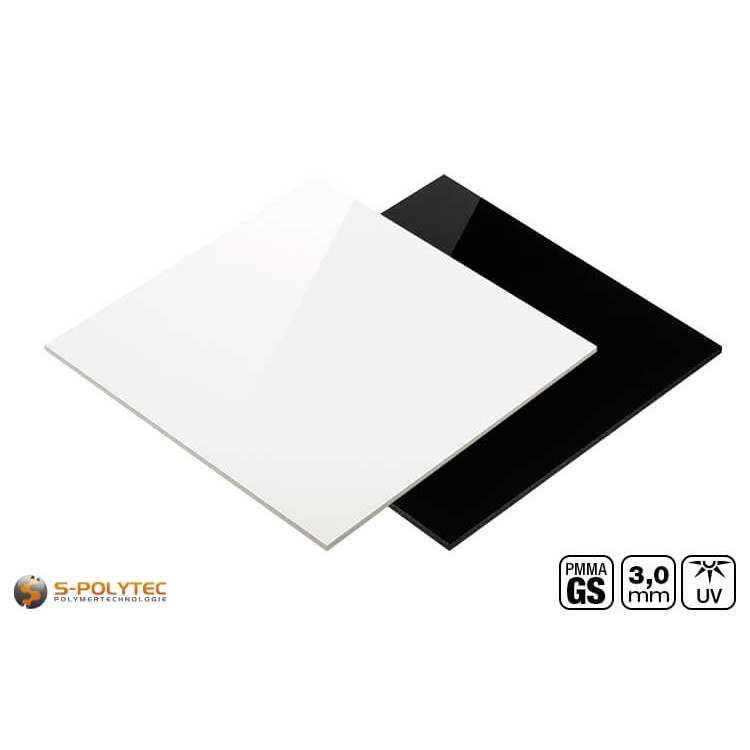
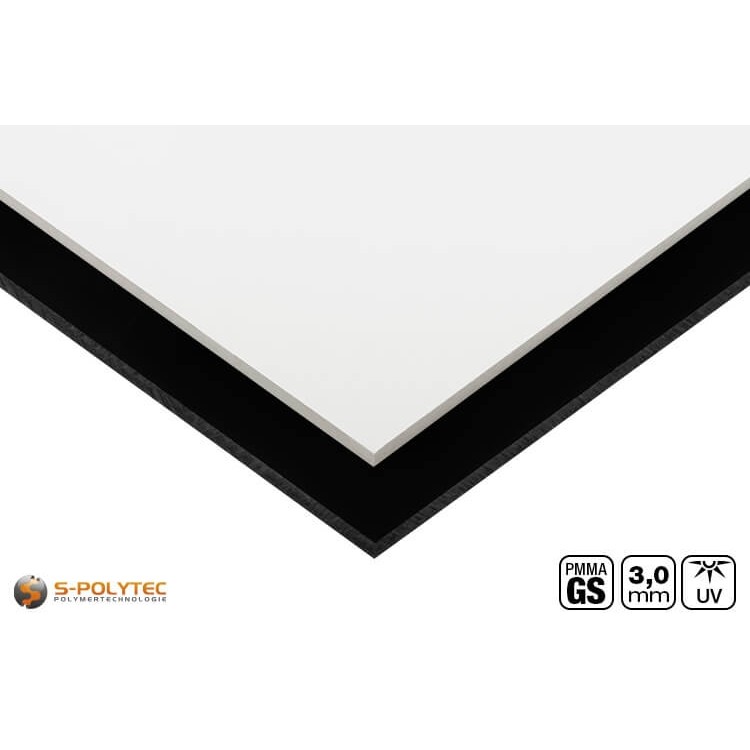
Our opaque cast acrylic GS cut to size is available in white and black. The opaque acrylic sheets are virtually non-transparent and are ideal wherever visibility through the material or light transmission is not desired. Thanks to the uniform solid colouring, both the surfaces and the cut edges have the same colour, creating a high-quality, homogeneous appearance.
✓ Opaque acrylic
✓ Virtually non-transparent – ideal for cladding
✓ Uniformly coloured throughout
✓ UV-resistant and weather-resistant
✓ High-gloss, smooth surface
Our white and black acrylic sheets are available custom cut to size with millimetre precision and are ideal for furniture construction, displays, cladding and design projects. You can find additional versions in our category acrylic sheets custom cut to size.
The item is in stock
Dispatch within 2-3 working days
- Panels in Cut
- at pieces 0,00 € (Base Price 0,00 € / m2)
- at pieces 0,00 € (Base Price 0,00 € / m2)
- at pieces 0,00 € (Base Price 0,00 € / m2)
Volume discount
All prices include 19% VAT.
Base Price
0,00 € / m2
0,00 € / pc.
0,0000kg / pc.
0,00 € / pc.
0,0000kg / pc.
All prices include 19% VAT.
Your price
€0.00
Incl. 19% Tax
Weight: 0,0000kg
- Description
Buy opaque cast acrylic GS cut to size online
UV-resistant & weather-resistant ✓ Highly resistant to ageing ✓ Opaque ✓
We offer opaque cast acrylic GS sheets cut to size in a thickness of 3mm, available in black or white and manufactured to your required dimensions at competitive prices. The solid sheets are not transparent but opaque and therefore have very low light transmission of no more than 5%. Cast acrylic GS offers excellent UV and weather resistance as well as outstanding resistance to ageing. The uniform colouring of the solid black or white sheets ensures that the cut edges and surfaces have exactly the same colour. The hard surface typical of acrylic is comparatively resistant to scratching and has a high-gloss finish. Casting produces surfaces with an outstanding finish. Both sides are protected against impacts and scratches by a robust protective film that can be removed easily.
We offer opaque acrylic sheets online, custom cut to size with millimetre precision and at competitive prices. Even very small pieces from 30mm x 30mm are available. The largest size offered online is 1500mm x 1000mm. Larger formats up to 3050mm x 2030mm are available on request. Cutting is carried out using a modern CNC panel saw with a low sawing tolerance of 1mm. As a result of sawing, the rough-sawn cut edges have a matt finish rather than the polished appearance produced by laser cutting.
Properties of opaque cast acrylic GS cut to size
Cast acrylic GS is manufactured by casting rather than extrusion. This means that no internal stresses are created in the sheet during production, greatly reducing the risk of stress cracking during laser cutting or bonding. The high pigment content creates an opaque sheet that is uniformly coloured throughout and has an outstanding surface finish. Opaque means that it is not possible to see through the sheets, making them ideal as privacy screens or for wall and furniture cladding. Due to the sheet thickness of 3mm, however, the sheets are not completely lightproof, so a very small amount of light may still be visible when exposed to strong light sources. In general, the lighter the sheet, the higher the light transmission, which decreases considerably as the sheet thickness increases. White sheets have the highest light transmission, which is still approximately 5% for a 3mm sheet.
- White cast acrylic GS: similar to RAL9010 (pure white), opaque, light transmission approx. 5%
- Black cast acrylic GS: similar to RAL9005 (jet black), opaque, light transmission approx. 1%
Acrylic sheets can be used for both indoor and outdoor applications. PMMA absorbs only extremely small amounts of water and, with water absorption of 0.3% over 24 hours (0.5% over 8 days), is considered a waterproof plastic. Acrylic is also very suitable for outdoor use in terms of UV and weather resistance. The weather resistance of cast acrylic is even slightly better than the already excellent resistance of extruded acrylic. Even after years of continuous UV exposure, there is therefore no need to fear fading of the black sheets or yellowing of the white sheets. These are ideal conditions for using opaque custom-cut acrylic as cladding or an outdoor privacy screen.
Application examples for opaque acrylic
The opaque acrylic sheets cannot be seen through and, despite their low thickness, are considered virtually non-transparent because of their very low light transmission. This makes the sheets ideal as light screens and privacy screens for indoor and outdoor use. Whether used as privacy screens between balconies, cladding for roller shutter boxes indoors or outdoors, or decorative fence elements, the opaque sheets provide a high-quality appearance thanks to their glossy surface.
Acrylic features comparatively scratch-resistant surfaces with a high-gloss finish and is therefore often used to enhance furnishings such as shelves, cabinet doors and tabletops. Because the sheets are opaque, they conceal the grain, colours and patterns of the surfaces underneath. Scratches, dents and damage to old furniture or tiled splashbacks do not show through the opaque sheets, allowing them to be visually upgraded easily and cost-effectively.
As a waterproof sheet material, acrylic can also be used very effectively in wet rooms, for example as a shower splashback or wall cladding above a bathtub. Combining plain white sheets with coloured transparent sheets or our black sheets provides almost unlimited creative freedom when designing a bathroom.
- White cast acrylic GS is used as a substrate for direct printing and provides an excellent high-gloss surface
- Opaque acrylic in black or white is popular as decorative cladding for walls, shelves and cabinets
- Opaque acrylic is ideal as an alternative to tiled splashbacks because the joints underneath do not show through
- Acrylic is waterproof and therefore ideal as a shower splashback or wall cladding in bathrooms and toilets
- Thanks to their glossy surfaces, opaque acrylic sheets are used for decorative exhibition and shop designs
- The glossy sheets are suitable as privacy screens for balconies, fence elements and exterior cladding
- and many other applications
Processing cast acrylic sheets
Acrylic is a thermoplastic with high surface hardness that can be processed in many different ways. Machining, laser cutting and engraving are among the most common methods used for PMMA. Acrylic can also be printed, lettered and bonded.
Cutting and drilling cast acrylic GS
Our acrylic sheets are supplied custom cut to size with millimetre precision, so further cutting is usually unnecessary. Nevertheless, the material is very easy to saw. If the sheet rests firmly on a solid surface and a saw blade with medium-density teeth is used, cuts and cut-outs should be easy to produce. However, the rotational speed or stroke rate of the saw must be reduced to prevent the saw blade from becoming too hot and causing the chips to melt into the cut edge. The same applies to all other machining methods, such as milling. A low speed, reduced feed rate and suitable milling cutter produce the best results without risking breakage of the sheet or excessive heating of the tool.
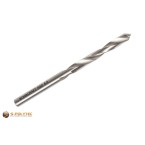
Drilling acrylic requires a little more care because of the hard surface and brittleness of the material. If the sheet rests firmly on a supporting surface so that it cannot flap or vibrate during drilling, it can nevertheless be drilled quite well using standard HSS drill bits. Do not apply pressure to the drill bit, as this may cause the sheet to chip or even break when the drill exits. As with sawing and milling, it is important to prevent the drill bit from becoming too hot. The easiest way to achieve this is to significantly reduce the speed of the cordless drill. A type HK drill bit for plastics, which is specifically designed for drilling brittle plastic sheets such as acrylic, reduces the risk of excessive heat generation thanks to its elongated spiral flute. Its sharp tip with a narrow point angle penetrates the hard surface more easily and accurately, producing precise, perfectly round holes.
Machining processes such as drilling, milling and sawing leave the edges matt and cloudy. These edges can be smoothed by repeated sanding with a sanding block or sandpaper in increasingly fine grits and then polished with a special acrylic polishing paste such as our PMMApolitur, producing a gloss comparable to that of the sheet surfaces. Alternatively, rough-sawn edges can be flame-polished. Extreme care is required, however, because acrylic can burn during flame polishing if the gas torch remains in one place for too long.
Instead of sawing or milling, acrylic can also be cut using a CO² laser. Laser cutting makes it possible to create custom contours, cut-outs and perfectly circular holes with very high dimensional accuracy. Because laser cutting is contactless, there is also no risk of the sheet breaking during processing or of the edges chipping. Another advantage of laser cutting is the quality of the cut edge, which is uniformly smooth and appears almost polished rather than rough and cloudy as with machining processes.
Printing, painting and applying film to cast acrylic GS
White acrylic sheets are ideal for use as wall decorations. Many online print shops offer this high-quality material with its high-gloss surface for direct printing with a custom design. Unlike transparent acrylic sheets, however, the design is not printed on the back but directly onto the surface. The print on the front is often protected against UV radiation and damage by an additional transparent acrylic sheet of the same size.
Black acrylic sheets are not suitable for direct printing. This is not because printing would be impossible, but simply because the print would be barely visible on the black surface. Both sheet colours are equally suitable for applying digital prints, adhesive lettering or paint.
Bonding and sealing cast acrylic GS
The coloured acrylic sheets can be bonded extremely well to one another and to many other plastics. With our acrylic adhesive PMMAprofi, we offer an affordable special adhesive that permanently and securely bonds plastics using a cold-welding process. Due to its water-like viscosity, the adhesive penetrates even the finest gaps. Cast acrylic does not need to be annealed because the complex manufacturing process used for the opaque sheets leaves them free from internal stresses, so stress cracks caused by contact with solvents are not to be expected.
When acrylic is bonded to tiles, masonry or plasterboard as a kitchen splashback or shower wall, a strong assembly adhesive is the right choice. Solvent-based adhesives are suitable for plastics but cannot dissolve construction materials such as wood, plaster or stone. Our Parabond 600 MS polymer, which is also available in black and white, provides a secure bond for the sheets on almost all substrates. This adhesive and sealant is also highly suitable for covering furniture with the high-gloss sheets or for bonding the sheets to ceilings.
Cleaning cast acrylic GS
Acrylic has high surface hardness and is therefore less prone to scratching than most other plastics. Nevertheless, the high-gloss surfaces should only be cleaned using a soft, lint-free cloth. Solvent-based plastic cleaners and aggressive household cleaners containing alcohol should also be avoided because they may attack the acrylic. Cleaning acrylic sheets is straightforward with a mild soap solution or a special acrylic cleaner such as our PMMAclean with antistatic effect.
NOTE: Like all acrylic sheets in our shop, our opaque custom-cut acrylic sheets are covered with protective film on both sides. This protects the surfaces against scratches that could occur before or during processing. The film can be removed easily. Depending on the processing method, it must be removed beforehand. This applies, for example, to printing, applying adhesive film, bonding, laser cutting and engraving.
- Additional Information
Additional Information
Product-ID 51500C Thickness 3 Delivery Time Dispatch within 2-3 working days Plastic Acrylglas Material PMMA Standard width 1500 Standart Length 1000 Fire behaviour Normal flammability UV resistance UV resistant Color No Color accuracy Color similar to RAL color system - Reviews
- Attachments