
Calculate plastic sheet deflection & determine the appropriate sheet thickness
Posted on May 30, 2026
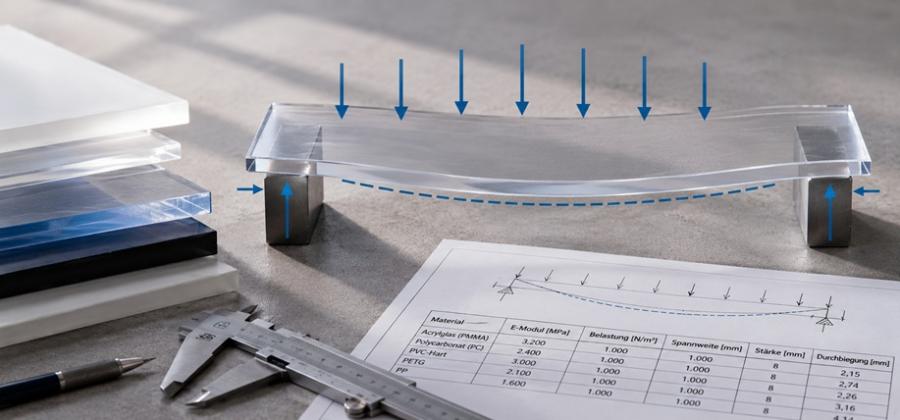
Use our deflection and sheet-thickness calculator to quickly estimate how far acrylic glass, polycarbonate, PVC, PE, PP, PETG and other plastics will bend under load and which material thickness is recommended for your application.
What is the correct sheet thickness? Especially for covers, viewing panels, shelves, machine guards and technical plastic sheets, the required material thickness depends heavily on the span, load, support and material. Our deflection calculator provides an approximate indication of how far a sheet will bend under a uniformly distributed load.
In this blog, we explain which factors affect deflection, how various plastic sheets differ in stiffness and how to interpret the calculator results correctly. Supported materials include acrylic glass, polycarbonate, PETG, rigid PVC, ABS, PE, PP, PTFE, HPL and aluminium composite sheets.
What does deflection mean for plastic sheets?
Deflection is the deformation of a sheet between its support or fastening points. When a plastic sheet is loaded, the amount it yields depends on the material, sheet thickness, span and support conditions.
A small amount of elastic deflection is normal in many applications. If deformation becomes too great, however, it can impair the appearance, function or usability of the construction.
- Covers: Excessive deflection can cause visible sagging.
- Shelves: Loaded sheets can sag noticeably between their supports.
- Viewing and protective panels: A sufficiently rigid design improves dimensional stability.
- Machine guards: Large unsupported sheet areas may require greater thickness or additional support.
- Outdoor applications: In addition to deflection, wind, snow, temperature and fastening must be considered.
Important: The calculator is intended for preliminary technical planning and approximate assessment. It does not replace structural calculations or regulatory verification. Load-bearing, fall-protection or other safety-relevant structures require professional assessment.
Calculate deflection and sheet thickness
Enter the material, free span, sheet width, existing thickness, support condition and additional area load. The calculator determines an approximate deflection and compares it with the selected limit.
Calculation principle: The calculator uses a simplified beam or strip model with typical material values. Actual sheets may behave differently depending on support, geometry, temperature, long-term loading and two-dimensional plate action.
Which factors affect deflection?
The required sheet thickness is not determined by a single value. For a meaningful selection, the span, material, thickness, load and support condition must be considered together.
| Factor | Effect on deflection |
|---|---|
| Span | The greater the unsupported distance between support points, the more the sheet can deflect. |
| Material | Materials with a higher Young's modulus are stiffer than softer plastics with comparable geometry. |
| Sheet thickness | Greater material thickness strongly increases flexural rigidity and can substantially reduce deflection. |
| Load | Self-weight and additional loads increase deformation. |
| Support condition | Simply supported, fixed and cantilevered sheets behave differently under load. |
| Temperature | Many plastics soften at higher temperatures and may deform more under permanent load. |
Practical tip: Additional support can greatly reduce the free span. In many constructions, this is more effective than increasing sheet thickness only slightly.
Comparison of the stiffness of different sheet materials
The following overview provides a rough classification by flexural rigidity. It is intended as guidance and does not replace a calculation for the specific format and load.
| Material | Stiffness | Typical application |
|---|---|---|
| Aluminium composite sheet | very high | Cladding, signs and wall panels |
| Compact HPL sheet | very high | Facades, balcony cladding and robust coverings |
| Acrylic glass GS / XT | high | Viewing panels, displays and covers |
| Rigid PVC | high | Technical sheets and cladding |
| Polycarbonate | medium | Protective glazing and impact-resistant panels |
| PETG | medium | Protective panels and transparent cladding |
| PP | low to medium | Chemical-resistant and technical components |
| PE | low | Wear strips, cutting boards and technical applications |
| PTFE | very low | Sliding and sealing technology |
Important: Aluminium composite sheets and HPL have a different material and sheet structure from conventional homogeneous thermoplastic sheets. The calculation is therefore only a simplified approximation for these materials.
Material data in the deflection calculator
The calculator uses typical guideline values for Young's modulus and density. Actual values may vary with material grade, manufacturer, temperature, colour, sheet construction and long-term load.
| Material | Young's modulus | Density | Note |
|---|
Note: For safety-relevant calculations, use the specific technical data for the sheet actually being installed.
Guideline values for typical applications
The following values are only rough guidance for typical applications that are not safety-relevant. The span, support, load, temperature and required dimensional stability may require a different thickness.
Acrylic glass as a viewing panel or cover
| Span | Rough sheet-thickness guidance |
|---|---|
| up to approx. 400 mm | 3–4 mm |
| up to approx. 700 mm | 5–6 mm |
| up to approx. 1000 mm | 8–10 mm |
Polycarbonate as a protective panel
| Span | Rough sheet-thickness guidance |
|---|---|
| up to approx. 500 mm | 4 mm |
| up to approx. 800 mm | 6 mm |
| up to approx. 1200 mm | 8–10 mm |
PE and PP sheets as technical covers
| Span | Rough sheet-thickness guidance |
|---|---|
| up to approx. 300 mm | 8 mm |
| up to approx. 600 mm | 10–15 mm |
| up to approx. 1000 mm | 20 mm and thicker |
Important: These tables do not constitute general technical approval. Use the calculator or reliable technical data for the specific application and consider the actual construction.
Why do PE and PP sheets deflect more?
PE and PP have a significantly lower Young's modulus than acrylic glass, rigid PVC or HPL. With the same thickness, span and load, their elastic deflection is therefore generally greater.
- Reduce the span: Additional support points reduce the unsupported area.
- Increase sheet thickness: A thicker sheet substantially increases flexural rigidity.
- Add a substructure: Profiles or braces can provide additional support for large sheets.
- Allow for long-term loading: Material-specific creep must be considered under permanent loads.
In return, PE and PP offer other material-specific advantages, such as high toughness, good chemical resistance and, depending on the grade, good sliding or wear properties.
Allow for temperature and thermal expansion in plastic sheets
Plastics react more strongly to temperature changes than many metals. Many plastics lose stiffness at higher temperatures. At the same time, plastic sheets change dimensions through thermal expansion.
- Temperature: Higher temperatures can reduce material stiffness.
- Thermal expansion: Sheets require sufficient movement clearance.
- Fasteners: Holes and mounting systems must allow for material movement.
- Outdoor applications: Wind, snow and temperature must be considered in addition to self-weight.
The approximate expansion of different materials under temperature changes can be calculated with our thermal-expansion calculator for plastic sheets.
When planning HPL sheets as a privacy screen in the garden or on a patio, sheet thickness, panel size, substructure, movement clearance and wind load must be considered together. The complete construction is explained in our blog Build your own privacy screen from HPL sheets.
Our blog also explains how to saw and route HPL sheets after selecting the appropriate thickness: Cutting HPL sheets.
Order plastic sheets cut to size
S-Polytec supplies plastic sheets cut to size for numerous technical and design applications. Select the material, thickness and format to suit your project.
| Material | Typical properties relevant to sheet selection |
|---|---|
| Acrylic glass | Transparent, comparatively rigid and suitable for visually demanding applications. |
| Polycarbonate | Transparent and particularly impact-resistant. |
| PETG | Transparent, tough and easy to form. |
| Rigid PVC | Relatively rigid and suitable for numerous technical applications. |
| PE | Tough and chemical-resistant, but considerably more flexible than more rigid sheet materials. |
| ABS | A tough technical plastic with good machinability. |
| PP | Lightweight and chemical-resistant, with lower stiffness than acrylic glass or rigid PVC. |
| PTFE | Highly resistant to chemicals and temperature, but comparatively soft. |
| HPL | A very rigid compact sheet for robust applications. |
| Aluminium composite sheets | High flexural rigidity due to the multilayer composite construction. |
Tip: Use the calculator for an initial approximate selection, then check which available thicknesses and formats are suitable for your project.
Frequently asked questions about deflection and sheet thickness
Which plastic sheet is particularly rigid?
The particularly rigid materials in the calculator include compact HPL and aluminium composite sheets. Among transparent solid plastics, acrylic glass is stiffer than polycarbonate or PETG.
Which sheet is stiffer: acrylic glass or polycarbonate?
Acrylic glass typically has a higher Young's modulus and is therefore stiffer with comparable geometry. Polycarbonate is much more impact-resistant and is often used when high fracture and impact resistance are more important.
Why is the span so important for plastic sheets?
Deflection increases sharply as the free span grows. Additional support or a shorter distance between support points can therefore reduce deformation considerably.
How can the deflection of a plastic sheet be reduced?
Deflection can be reduced by increasing sheet thickness, shortening the free span, adding support points or selecting a stiffer material.
What sheet thickness do I need for a shelf?
There is no universally suitable thickness. It depends on material, span, width, support, self-weight and additional load. The deflection calculator provides an approximate combined assessment of these factors.
Does the calculator include the self-weight of the plastic sheet?
Yes. Self-weight is calculated from the stored material density and entered sheet thickness and is included together with the additional area load.
Can the deflection calculator replace a structural calculation?
No. The calculator is a simplified estimate for preliminary planning and guidance. Load-bearing, safety-relevant, regulated or heavily loaded structures require professional calculation.