
Calculate thermal expansion of plastic sheets – table & calculator
Posted on May 18, 2026
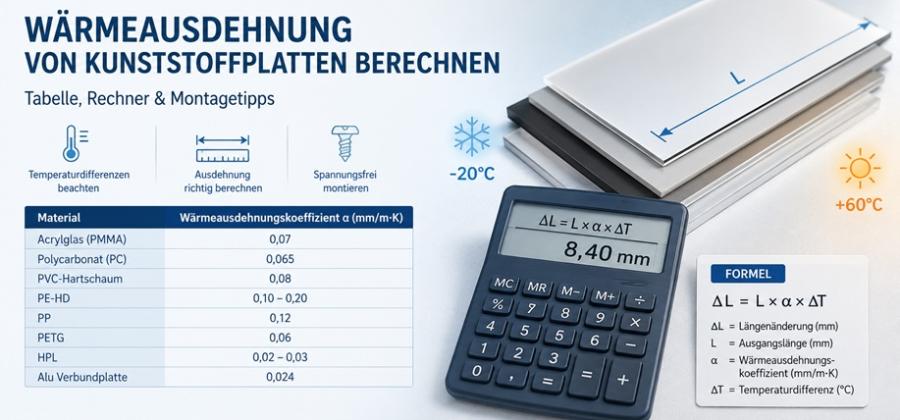
The thermal expansion of plastic sheets must be considered, particularly outdoors. Use our calculator to determine the thermal change in length of different materials quickly and easily.
Plastic sheets change their dimensions when temperatures fluctuate. When heated, they expand; when cooled, they contract again. This thermal expansion must be taken into account during planning and installation, particularly for façade cladding, privacy screens, balcony cladding, covers and other large-format applications.
In this blog, we explain how to calculate thermal expansion, which plastic sheets expand more or less and what to consider with regard to fasteners, drill holes and expansion clearance. Our calculator allows you to estimate the thermal expansion of acrylic glass, polycarbonate, PVC, PE, PP, PETG, HPL, aluminium composite sheets and other materials directly.
Why is thermal expansion important for plastic sheets?
Plastics respond more strongly to temperature changes than many metallic materials. When a sheet becomes warmer, its length increases. When the temperature drops, the material contracts again.
The extent of this change in length depends primarily on the material, the sheet length and the temperature difference.
- Large sheet sizes: The longer the sheet, the greater the absolute change in length.
- Outdoor use: Summer and winter can cause considerable temperature differences.
- Dark surfaces: They can become significantly hotter in direct sunlight.
- Rigid fastening: Insufficient expansion clearance can cause stress and deformation.
- Drill holes and joints: They must be designed to allow the sheet to move.
Important: If thermal expansion is not taken into account, stress, waviness, deformation or, in the worst case, cracks and damage at the fastening points may occur.
Formula for calculating thermal expansion
The approximate thermal change in length can be calculated using a simple formula:
ΔL = L × α × ΔT
| Symbol | Meaning |
|---|---|
| ΔL | Change in sheet length in mm |
| L | Initial sheet length in mm |
| α | Linear coefficient of thermal expansion of the material in 1/K |
| ΔT | Temperature difference in K or °C |
The greater the sheet length and temperature difference, the greater the absolute change in length. The material-specific coefficient of thermal expansion also affects the result.
Note: For temperature differences, the numerical value in kelvin and degrees Celsius is identical. A temperature change of 40 °C therefore corresponds to a temperature difference of 40 K.
Calculate the thermal expansion of plastic sheets
Select the material and enter the sheet length and expected temperature difference. The calculator will then estimate the thermal change in length.
mm
°C
Calculated change in length
–
Enter your values and start the calculation.
Note: The stored coefficients of thermal expansion are typical guide values. Actual values may vary depending on the material type, manufacturer, temperature range, sheet construction and specific design.
Comparison of the thermal expansion of different materials
The following table shows typical linear coefficients of thermal expansion. The higher the value, the more the length of a workpiece changes for the same temperature change.
| Material | α in mm/m·K | Typical application |
|---|---|---|
| Acrylic glass | approx. 0.07 | Viewing panels, glazing and covers |
| Polycarbonate | approx. 0.065 | Protective glazing and machine guards |
| PETG | approx. 0.06 | Protective screens and transparent cladding |
| Rigid PVC | approx. 0.08 | Technical sheets and cladding |
| ABS | approx. 0.07–0.10 | Housings and technical components |
| PE | approx. 0.10–0.20 | Tank construction and technical applications |
| PP | approx. 0.12 | Tank construction and components exposed to chemicals |
| PTFE | approx. 0.12–0.20 | Sliding, sealing and chemical engineering applications |
| Compact HPL sheets | approx. 0.02–0.03 | Façades, privacy screens and balcony cladding |
| Aluminium composite sheets | approx. 0.024 | Façades, wall cladding and roof-edge cladding |
| Aluminium | approx. 0.023 | Profiles and substructures |
| V2A stainless steel | approx. 0.016 | Fasteners and metal structures |
| Steel | approx. 0.012 | Substructures and steel construction |
| Glass | approx. 0.009 | Glazing |
Material properties: The values are typical guide values. Further information about our sheet materials can be found in the technical data sheets for plastic sheets.
Example calculation: thermal expansion of acrylic glass
A 3000 mm long acrylic glass sheet is installed outdoors. A temperature difference of 40 °C is assumed between the two temperature states under consideration.
| Sheet length | 3000 mm |
|---|---|
| Coefficient of thermal expansion | 0.00007 1/K |
| Temperature difference | 40 K |
| Calculation | 3000 × 0.00007 × 40 |
| Change in length | 8.4 mm |
The calculated change in the sheet's length between the two temperature states is therefore approximately 8.4 mm. This movement range must be taken into account in the design and fastening system.
Important: The 8.4 mm represents the total change in length between the two assumed temperature states. The expansion clearance required at each sheet edge depends on the specific installation design and the reference point of the fastening system.
Which materials expand particularly strongly?
There are significant differences between the various sheet materials. Materials with a high coefficient of thermal expansion require correspondingly more expansion clearance when used in large sizes.
| Classification | Materials |
|---|---|
| High thermal expansion | PE, PP and PTFE |
| Medium thermal expansion | Acrylic glass, polycarbonate, PETG, rigid PVC and ABS |
| Lower thermal expansion | Compact HPL sheets and aluminium composite sheets |
| Metallic reference materials | Aluminium, stainless steel and steel |
The lower thermal change in length of HPL and aluminium composite sheets does not mean that no expansion clearance is required during installation. Sheet size, temperature range and the relevant fastening system must also be considered for these materials.
Allowing for thermal expansion during installation
Plastic sheets should be installed so that temperature-related material movement is not prevented by rigid fastening.
- Use adequately sized drill holes: The sheet requires expansion clearance around the fastener.
- Do not clamp rigidly: Screws and fasteners must not completely block the necessary material movement.
- Allow for expansion joints: There must be sufficient clearance between the sheets and adjacent components.
- Divide large sheet areas: Smaller sections reduce the absolute change in length of each element.
- Consider dark sheets: Greater heating from sunlight can cause larger temperature differences.
Drilling and fastening acrylic glass correctly
Our blog explains how to create clean drill holes and allow sufficient movement for subsequent screw fastening: Drilling and fastening acrylic glass correctly.
Fixed and sliding points for HPL sheets
With HPL sheets, the necessary material movement is accommodated in part through fixed and sliding points. We explain how to make the drill holes in detail in our blog: Drilling HPL sheets.
You can also find guidance on supporting, securing, sawing and routing in our blog: Cutting HPL sheets.
Thermal expansion in outdoor applications
In outdoor applications, factors other than material expansion affect the structure. The calculated change in length must therefore never be considered in isolation.
| Factor | What to consider during planning |
|---|---|
| Sunlight | The surface temperature can be significantly higher than the air temperature. |
| Sheet colour | Dark surfaces can become hotter than light surfaces. |
| Sheet size | Large sheets have a greater absolute change in length. |
| Substructure | It must allow material movement while remaining sufficiently stable. |
| Wind and snow | Additional mechanical loads must be considered independently of thermal expansion. |
| Fastening | Hole pattern, fastening points and expansion clearance must be coordinated. |
Anyone planning to use HPL sheets as a freestanding privacy screen in a garden or on a patio must therefore consider the panel layout, sheet thickness, substructure, posts, wind loads and anchoring in addition to thermal expansion. We explain the construction in our blog: Build your own privacy screen from HPL sheets.
Additional planning: In addition to thermal expansion, deflection can also be a decisive factor for unsupported sheets. For an approximate preliminary assessment, you can use our plastic sheet deflection calculator .
Thermal expansion of plastic sheets: key points at a glance
The thermal change in the length of a plastic sheet is determined primarily by the sheet length, temperature difference and material-specific coefficient of thermal expansion. PE, PP and PTFE in particular change their dimensions comparatively strongly, while HPL and aluminium composite sheets have lower values.
It is essential to allow for the expected material movement when planning drill holes, fastening points, joints and the substructure. This helps prevent temperature-related stress and deformation.
Suitable plastic sheets cut to size are available from S-Polytec in numerous materials, thicknesses and formats.
Frequently asked questions about the thermal expansion of plastic sheets
How do you calculate the thermal expansion of a plastic sheet?
The approximate change in length is calculated using the formula ΔL = L × α × ΔT. You need the initial sheet length, the material's coefficient of thermal expansion and the temperature difference.
Which plastic expands particularly strongly when heated?
PE, PP and PTFE are among the plastics with comparatively high thermal expansion. For large dimensions and high temperature differences, they require correspondingly generous expansion clearance.
How much does acrylic glass expand when heated?
For an approximate calculation, a linear coefficient of thermal expansion of around 0.07 mm per metre and kelvin can be used for acrylic glass. A sheet measuring 3 m in length therefore changes by approximately 8.4 mm over a temperature difference of 40 K.
Why do drill holes in plastic sheets need to be larger?
For movable fastening points, a larger drill-hole diameter in the sheet can provide the necessary expansion clearance around the fastener. The specific design depends on the material and the fastening system used.
Do dark plastic sheets expand more?
The material-specific coefficient of thermal expansion is not determined by colour alone. However, dark surfaces can become hotter in sunlight, resulting in a greater temperature change and therefore a greater absolute change in length.
Must thermal expansion be considered for HPL sheets?
Yes. The dimensions of HPL sheets also change depending on temperature and ambient conditions. Suitable fastening points and sufficient expansion clearance must therefore be provided during installation.
Can the thermal-expansion calculator determine the exact joint width?
No. The calculator only estimates the total change in length between two temperature states. How this movement must be distributed across joints and fastening points depends on the specific installation and fastening system.