
Cutting HPL sheets – sawing, milling and producing clean edges
Posted on Aug 5, 2026
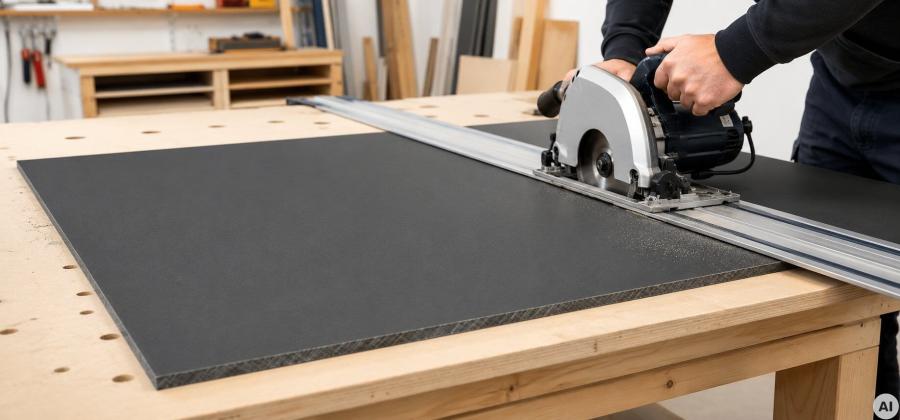
HPL sheets can be machined precisely with suitable saws and routers. This blog explains the key tools, safe preparation and typical mistakes to avoid when cutting HPL to size.
For clean cuts, HPL sheets must be supported fully and securely, clamped reliably and machined with sharp saw blades or cutters suitable for HPL.
In this blog, we show you how to prepare and produce straight cuts, cut-outs and contours. You will also learn how to finish cut edges, when professional cutting is advisable and why sheet thickness, weight, deflection and thermal expansion need to be considered during the planning stage.
What is important when cutting HPL?
HPL stands for High Pressure Laminate. Several layers of resin-impregnated paper are pressed together under high pressure and at high temperature. This creates a dense, dimensionally stable laminate with a robust surface.
The dense material structure calls for careful preparation: the sheet must be supported securely, must not move during machining and should be worked with sharp saw blades, cutters or drill bits suitable for HPL. Whether a straight cut is sufficient or contours, cut-outs and holes are also required depends on the finished component.
Important: Plan the finished component in full before starting any machining. Its length, width, sheet thickness, holes, cut-outs and subsequent fixing points should all be established before the first cut.
Solid-carbide HPL drill bits with a centring point, designed specifically for this purpose, are suitable for drilling HPL sheets. For outdoor applications, fixed points and sliding points must be planned to suit the fixing method and the possible thermal expansion.
Which method is right for my project?
| Task | Suitable tool |
|---|---|
| Straight cut | Hand-held circular saw, table saw or circular saw with a carbide-tipped saw blade |
| Smaller cut-outs or curves | Jigsaw with a fine blade suitable for hard sheet materials |
| Contours, recesses or edges | Router with a sharp carbide-tipped cutter |
| Several identical or particularly precise components | Professional CNC milling |
Simple straight cuts can be made in-house with the right equipment. For several identical parts, tight dimensional specifications or complex contours, professional production is generally more economical and reliable.
Planning an HPL component before cutting
The cut must suit the subsequent application. Particularly for facades, balcony cladding, privacy screens, covers or technical cladding, the sheet thickness, unsupported span, weight, fixing method and temperature changes must be considered together.
Consider sheet thickness, weight and thermal expansion
The deflection calculator provides an approximate way to check how far a sheet will deflect under load and which material thickness may be suitable for the intended application. For safety-critical, load-bearing or building-regulated applications, this calculation is not a substitute for structural verification.
Sheet weight affects handling, the substructure and installation. The weight calculator assists with preliminary planning.
HPL sheets expand when heated and contract again when cold. If this dimensional change is not taken into account in outdoor applications, stresses, deformation, rippling or cracks can occur. You can calculate the possible change in length with a thermal expansion calculator.
For outdoor applications, the fixing holes must be planned so that the sheet can move as temperatures change. Our blog Drilling HPL sheets explains how to make the holes and plan fixed points and sliding points correctly. We explain which fixing is suitable for wood, metal or aluminium and how fixed and sliding points are used during installation in our detailed blog Fastening HPL sheets. Our blog on balcony cladding with HPL sheets provides a practical example of planning and installation.
If you are instead planning a free-standing privacy screen in the garden or on the patio, you need to consider not only the sheet dimensions but also the panel layout, substructure, posts, wind loads, movement clearance and anchoring. We show the complete construction in the blog Build your own privacy screen from HPL sheets.
Which tools and equipment are required?
The basic equipment comprises a machine suitable for HPL, a sharp saw blade or matching cutter, and a stable work surface on which the sheet can be clamped securely. A tape measure, pencil and masking tape help to transfer the dimensions and cutting line clearly.
- For measuring and marking: Tape measure, pencil and masking tape if required.
- For supporting the sheet: A flat, load-bearing work surface.
- For securing the sheet: Clamps that hold the sheet securely on the work surface.
- For straight cuts: Hand-held circular saw, table saw or circular saw with a sharp carbide-tipped blade.
- For cut-outs and curves: Jigsaw with a fine blade for hard sheet materials.
- For contours and edges: Router with a sharp carbide-tipped cutter.
For clean cuts, the saw blade should be sharp, fine-toothed and suitable for hard sheet materials. Carbide-tipped alternate-top-bevel or triple-chip blades are often used in circular saws. Always observe the tool manufacturer's approvals and instructions.
Safety: Wear safety glasses during machining and ensure effective extraction or good dust removal. Protective gloves are useful when transporting sheets and handling sharp sheet edges. Also observe all safety and operating instructions for the machine and tools used.
Preparing the HPL sheet correctly
Place the HPL sheet on a flat, load-bearing work surface. The area along the cutting line must be supported adequately without obstructing the path of the machine. Then secure the sheet so that it cannot move while being sawn or milled.
If the HPL sheet has a protective film, this can help protect the surface against minor damage while marking and machining. Check beforehand whether the film may remain on the sheet during machining.
- 1. Determine the dimensions: Establish the length, width and quantity.
- 2. Mark the cutting line: Mark the intended cut in full and make sure it is clearly visible.
- 3. Check the dimensions: Verify all measurements again before making the first cut.
- 4. Support the sheet: Support the HPL sheet securely and evenly.
- 5. Secure the sheet: Clamp the workpiece so that it cannot move.
- 6. Check the working path: It must be possible to guide the machine safely along the entire cutting line.
Practical tip: A strip of masking tape along the intended cutting line makes clear marking easier and can provide additional protection for the surface during machining.
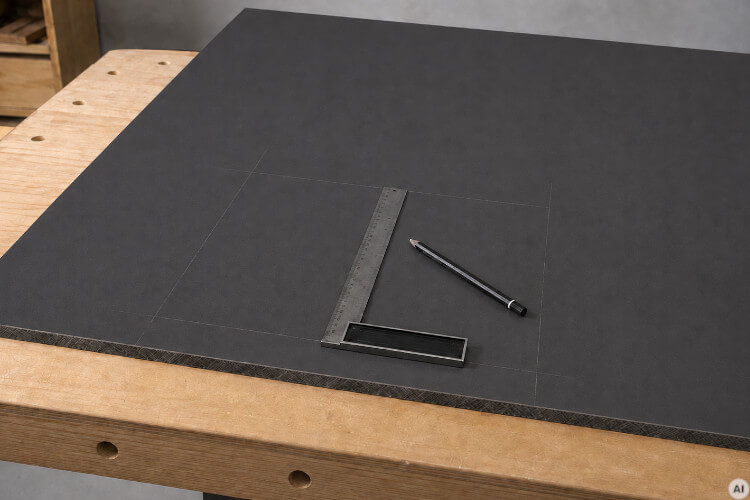
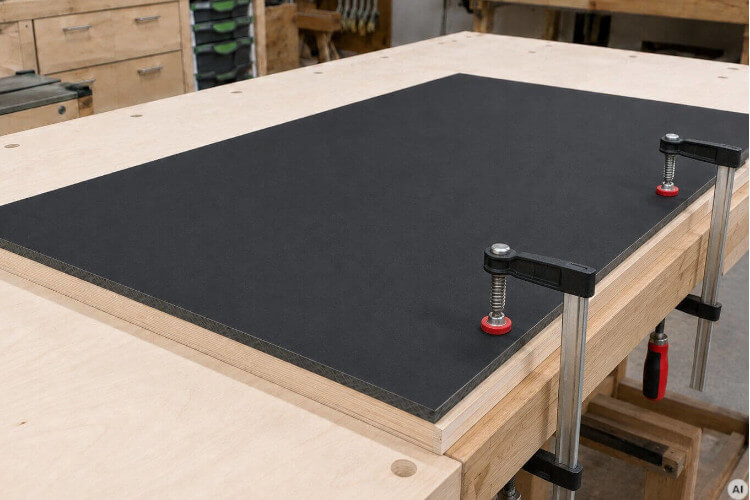
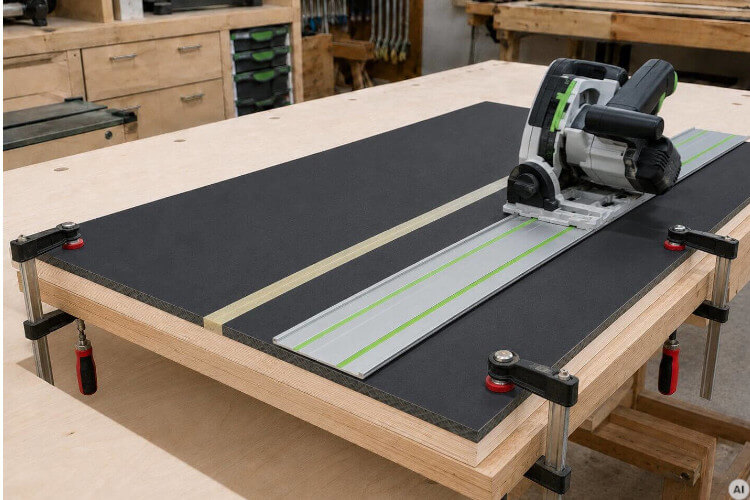
Transfer the dimensions, support the HPL sheet securely and keep the machine's working path clear.
Practical note: If the work surface is not large enough to support and guide the sheet safely, have it machined professionally.
Preparing and sawing the HPL sheet
Straight cuts with a circular or hand-held circular saw
For longer straight cuts, a hand-held circular saw, table saw or circular saw with a sharp carbide-tipped blade is suitable. A guide rail makes it easier to guide the machine evenly along the marked line.
The sheet must remain fully supported and securely clamped throughout the sawing process. Guide the machine smoothly and steadily through the material. Heavy additional pressure will not improve the cut and makes controlled guidance more difficult.
Cut-outs and curves with a jigsaw
A jigsaw can be used for smaller cut-outs and curved contours. Use a fine blade suitable for hard sheet materials and secure the sheet with as little vibration as possible.
The jigsaw's base plate should remain fully in contact with the surface while sawing. Guide the machine slowly and without excessive pressure along the marking. A strong pendulum action can encourage chipping on the surface. Therefore, use only a low setting or the setting recommended by the machine and saw-blade manufacturer.
- 1. Check the support: The sheet must lie securely and must not move.
- 2. Check the tool: Use a sharp saw blade suitable for the task.
- 3. Align the machine: Position the machine correctly against the marked line.
- 4. Make the cut: Guide the machine smoothly and steadily along the marking.
- 5. Check the result: Then inspect the dimensions, edge and surface.
If the sheet slips, vibrates heavily or the machine cannot be guided evenly, stop the process and adjust the support and clamping.
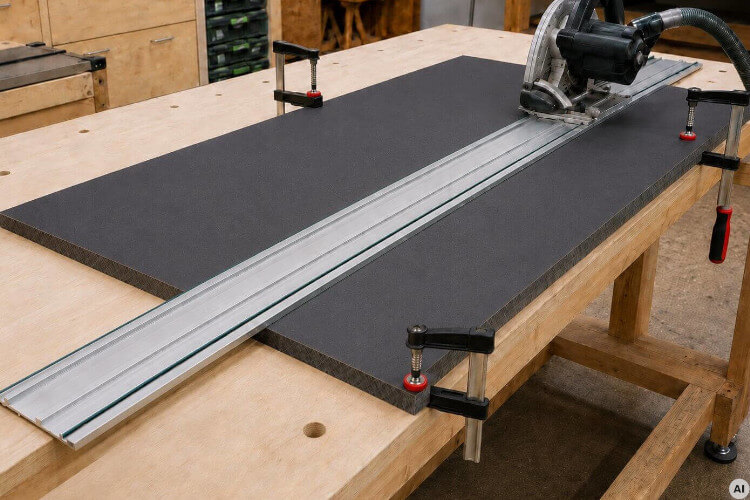
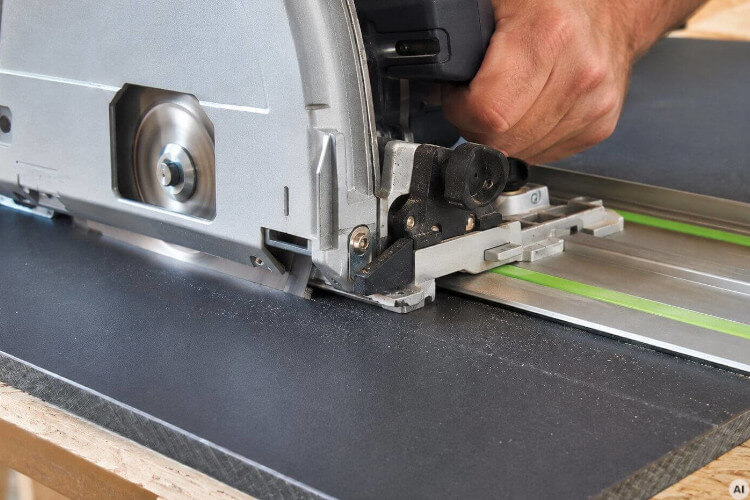
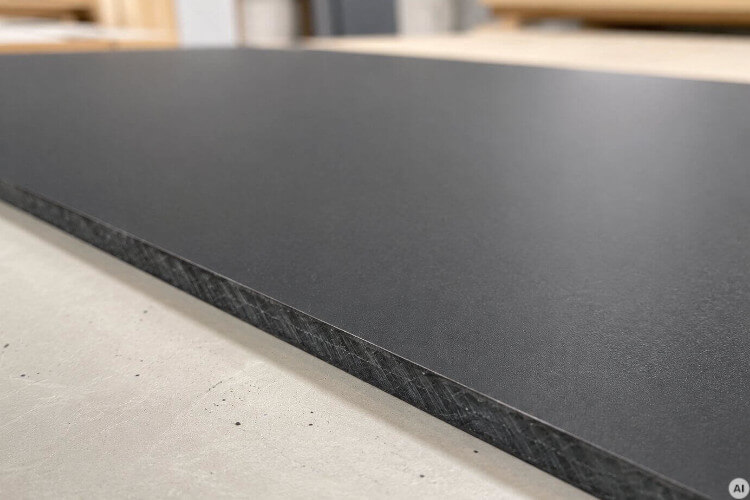
Support the HPL sheet securely, guide it along the cutting line in a controlled manner and then inspect the finished edge.
Producing cut-outs and contours
Milling is suitable for cut-outs, recesses and free-form contours. The following procedure serves as guidance for planning, clamping and inspection. Mark the shape, position and dimensions in full before clamping the sheet and starting to mill.
- Define the contour: Mark the shape, position and dimensions in full.
- Check the dimensions: Verify distances and positions again before milling.
- Secure the workpiece: The sheet must not move during machining.
- Check the tool: Use only suitable, sharp and undamaged cutters.
- Inspect the result: Check the contour, edge and surface after milling.
Professional CNC machining is recommended for complex shapes, where secure clamping is not possible or when tight dimensional specifications apply.
Final inspection of the cut and surface
After sawing or milling, inspect the dimensions, cut edge and decorative surface of the HPL sheet.
- Dimensions: Does the finished length or width match the plan?
- Edge: Is the cut edge even, or are there visible chips and irregularities?
- Surface: Is the decorative surface undamaged?
- Holes and cut-outs: Are their positions and dimensions correct?
Finish the cut edge if necessary
Small burrs or irregularities on the cut edge can be removed carefully with a fine file or fine-grit sandpaper. Work only on the cut edge and avoid sanding the decorative surface.
Depending on the desired appearance, visible edges can be lightly chamfered or rounded. Whether finishing is required depends on the quality of the edge and the component's subsequent use.
Identifying and avoiding typical mistakes
- The sheet moves: Stop the process and clamp the workpiece again.
- The machine cannot be guided safely: Recheck the working path and support.
- The edge becomes uneven: Check the tool, support and guidance.
- The surface is damaged: Stop working and inspect the support, guidance and tool.
- The sheet is too large or too heavy: Do not improvise; have it machined professionally.
- Thermal expansion was not considered: Recheck the dimensions and fixing method before installation.
When professional machining makes sense
In-house machining is worthwhile only if the sheet can be supported fully and securely, clamped safely and the appropriate machinery is available. If any of these requirements cannot be met, do not improvise.
| Situation | Suitable solution |
|---|---|
| Simple adjustment and suitable equipment available | In-house machining |
| Sheet is too large or too heavy | Professional cutting |
| Several identical parts are required | Professional cutting |
| Complex contours, cut-outs or holes | CNC milling service |
| Particularly precise dimensions required | Cutting or CNC milling service |
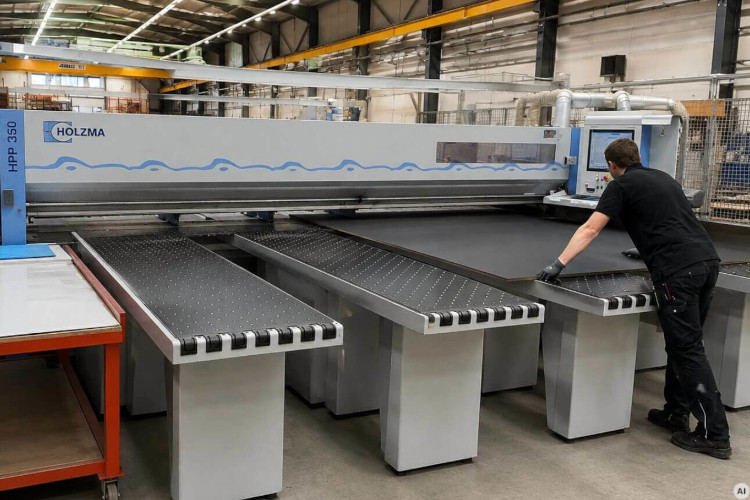
HPL sheets cut to specified lengths and widths are produced at S-Polytec on the HOLZMA HPP 350.
Suitable HPL sheets can be configured directly in the required size. S-Polytec guarantees a dimensional tolerance of ±1 mm for cut-to-size sheets. Further information about custom contours, cut-outs and holes can be found under our CNC milling service. Our CNC milling machines achieve a production tolerance of approximately ±0.3 mm on the X and Y axes.
Machining HPL sheets yourself: the key points at a glance
Straight cuts and simple adjustments can be made in-house with secure support, reliable clamping and sharp saw blades suitable for HPL. A well-prepared workplace is more important than completing the work as quickly as possible.
Plan all dimensions, sheet thickness, weight, holes, cut-outs and fixing points. Thermal expansion must also be taken into account for outdoor applications.
If the sheet cannot be supported or clamped safely, is too large for the workplace, or several identical or complex components are required, professional cutting or a CNC milling service should be selected.
Frequently asked questions about cutting and machining HPL sheets
Can you cut HPL sheets yourself?
Yes. Straight cuts and simple adjustments are possible if the sheet is supported securely, clamped safely and machined with a sharp saw blade suitable for HPL.
If the sheet is too large or heavy for the workplace, or cannot be clamped safely, do not improvise with the machining process.
Which saw is suitable for HPL sheets?
A hand-held circular saw, table saw or circular saw with a sharp carbide-tipped blade is suitable for straight cuts. A jigsaw with a fine blade for hard sheet materials can be used for smaller cut-outs and curves.
How should an HPL sheet be supported when cutting?
The sheet should lie on a stable, flat work surface. Adequate support is required along the cutting line so that the workpiece does not sag, vibrate or move during sawing.
How can you prevent an HPL sheet from moving while sawing?
Clamp the sheet securely without obstructing the path of the machine. The entire cutting line must remain clear and safely accessible.
How can cut edges be finished?
Small burrs or irregularities can be removed carefully with a fine file or fine-grit sandpaper. Work only on the edge and avoid sanding the decorative surface.
When should the work process be stopped?
Stop if the sheet moves, the machine cannot be guided evenly, the cutting line cannot be reached safely or significant surface damage occurs. Then check the support, clamping and tool.
Why must thermal expansion be considered before cutting?
HPL sheets expand when heated and contract when cold. If this dimensional change is not taken into account during cutting and installation, stresses, deformation, rippling or cracks can occur.
What needs to be considered regarding sheet thickness and deflection?
The appropriate sheet thickness depends, among other factors, on the span, load and support. The S-Polytec deflection calculator is intended as guidance and for preliminary planning, but does not replace structural verification for safety-critical or load-bearing applications.
When does professional cutting or a CNC milling service make sense?
A professional service makes sense if the sheet is too large or heavy for the available workplace, several identical parts are required, or complex contours, cut-outs and particularly precise dimensions are needed.