
Build your own acrylic glass aquarium: planning, cutting & bonding
Posted on Jul 24, 2026
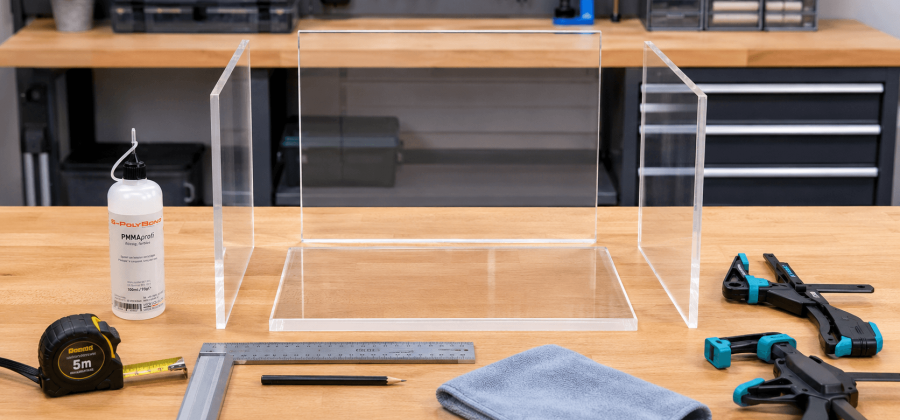
Want to build your own acrylic glass aquarium? In this blog, we explain what matters when planning the aquarium, selecting the material and sheet thickness, cutting, bonding and testing for leaks.
Building your own acrylic glass aquarium is an exciting project in which planning, material selection and workmanship are particularly important. Acrylic glass is transparent, considerably lighter than glass and less susceptible to breakage. However, to create a permanently watertight tank from individual acrylic sheets, the cutting, sheet thickness, bonding surfaces, joints and watertightness must be planned carefully.
Build your own acrylic glass aquarium: planning, cutting and bonding
Before you build your own acrylic glass aquarium, the tank must be planned precisely. Unlike a simple protective screen or cover, an aquarium is permanently subjected to the load of the water. Water pressure acts on the base, front panel, rear panel and sides. The higher the water level, the greater the load on the acrylic sheets.
It is therefore not enough to define only the external dimensions. The water height, tank length, edge construction, position of the side panels, support beneath the base and any cross braces are particularly important. The cover, filtration equipment, hoses, cable openings and other cut-outs should also be considered during the planning stage.
Even if you only intend to build a small acrylic glass aquarium, the water height, sheet thickness and bonded joints must not be underestimated. A compact tank already holds a considerable quantity of water and must remain permanently stress-free and watertight.
Which parts are needed for an acrylic glass aquarium?
- Base: Supports the tank and must rest on a completely flat, full-surface support.
- Front panel: Crucial for appearance, visibility and stability.
- Rear panel: Can be designed in transparent, opal or coloured acrylic glass.
- Side panels: Must fit the base and front panel precisely.
- Cover: Optional as splash protection, evaporation protection or an equipment cover.
- Bracing: Depending on the tank size and construction, additional braces or reinforcements may be required.
Important: This blog is not a substitute for a structural calculation. For larger aquariums, high water loads or structures permanently exposed to water, the sheet thickness, bonding and safety margins should be professionally designed.
Acrylic glass XT or GS for an aquarium?
Acrylic glass is a transparent PMMA-based plastic. Clear acrylic sheets are the primary option for transparent tanks, protective screens and structures permanently exposed to water. S-Polytec supplies acrylic glass XT and GS cut to size. Both versions are transparent, UV- and weather-resistant and can be machined precisely.
In everyday use, acrylic glass is also frequently searched for under well-known brand names, such as PLEXIGLAS®. Someone searching for how to build an aquarium from PLEXIGLAS® therefore usually means a tank made from transparent PMMA or acrylic sheets. You can learn more about the terminology, properties and differences in our blog What is the difference between PLEXIGLAS® and acrylic glass?.
Choosing the right material is particularly important for a high-quality acrylic glass aquarium. Acrylic glass XT is extruded PMMA and is suitable for many transparent applications. Acrylic glass GS is cast PMMA and offers particularly high surface quality. Compared with XT, GS has lower internal stress and is especially suitable for precise milling, polishing, engraving and laser cutting.
Acrylic glass XT – transparent and versatile
Acrylic glass XT is an economical and versatile option for transparent applications. It is crystal clear, lightweight, UV-resistant and weather-resistant. Transparent acrylic glass XT is available from S-Polytec in thicknesses of 2 mm, 3 mm, 4 mm, 5 mm, 8 mm and 10 mm.
XT can be a suitable choice for simple covers, smaller structures, terrarium applications and less critical projects. For aquariums permanently exposed to water, however, it must be carefully assessed whether XT is suitable for the particular construction.
Acrylic glass GS – high-quality appearance and low internal stress
Acrylic glass GS is cast and therefore has lower internal stress than extruded acrylic glass. This is particularly relevant when acrylic glass is to be milled, drilled, polished, engraved, laser cut or bonded. Acrylic glass GS can offer advantages for high-quality visible surfaces and precise bonded joints.
Transparent acrylic glass GS cut to size is available from S-Polytec in thicknesses of 3 mm, 4 mm, 5 mm, 8 mm and 10 mm. GS can therefore be of particular interest for an acrylic glass aquarium when clean edges, low material stress and precise bonding are important. Nevertheless, its suitability must always be assessed on the basis of the specific tank design.
You can find suitable transparent acrylic sheets in our category for transparent acrylic sheets cut to size. The sheets required for the base, front, rear, sides and cover can be configured individually.
Material selection: Acrylic glass GS can offer advantages for precise machining and high-quality visible surfaces due to its lower internal stress. However, whether XT or GS is suitable for a particular aquarium must always be assessed together with the sheet thickness, tank dimensions, bonding and permanent water load.
Sheet thickness and stability of an acrylic glass aquarium
Selecting the correct sheet thickness is one of the most important aspects of building an acrylic glass aquarium. It depends not only on the length and width of the tank but above all on the water height, construction, bonded joints, support and any bracing.
Water pressure increases with height. A low, small tank places considerably less stress on the front and side panels than a tall aquarium. The sheet thickness should therefore never be selected solely on the basis of the tank's footprint.
What determines the required thickness?
- Water height: The higher the water level, the greater the pressure on the panels.
- Tank length: Longer front panels can deflect more strongly.
- Construction: Braces, reinforcement strips and supports can affect stability.
- Material type: XT and GS differ in their manufacture, internal stress and machinability.
- Bonding: The bonding surfaces must be clean, accurately fitting and free from stress.
- Safety margin: An adequate safety reserve must always be included when planning for water loads.
S-Polytec supplies transparent acrylic sheets in several thicknesses. Acrylic glass XT is available in 2 mm, 3 mm, 4 mm, 5 mm, 8 mm and 10 mm. Transparent acrylic glass GS is available in 3 mm, 4 mm, 5 mm, 8 mm and 10 mm. The appropriate thickness for your aquarium must be determined from the specific design.
No universal rule: A general statement such as “10 mm is sufficient for every aquarium” would be incorrect. The tank dimensions, water height, construction, bonded joints and safety margin are always decisive.
Acrylic sheets cut to size for aquarium components
The success of an acrylic glass aquarium depends on precise cutting. The base, front, rear and side panels must fit together exactly so that the bonding surfaces make clean contact. Even small dimensional deviations can make bonding more difficult or introduce stress.
At S-Polytec, you can configure acrylic sheets cut precisely to the millimetre. Depending on the component, saw cutting, CNC machining, milling, drilling or laser cutting are possible. This allows you to plan not only rectangular sheets but also individual contours, cut-outs and openings for equipment.
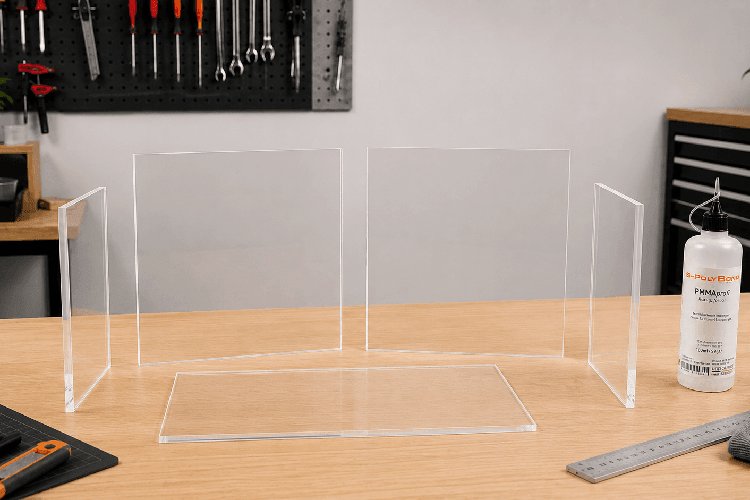
Which components are useful for an acrylic glass aquarium?
- Base cut to size: The foundation for assembling the tank accurately.
- Front and rear panels: Clear visible surfaces with a suitable thickness and clean edges.
- Side panels: Matched precisely to the base, front and rear panels.
- Cover: Optionally with cut-outs for equipment, a feeding opening or hoses.
- Drill holes: For equipment, mounting or cable openings where structurally appropriate.
- CNC or laser machining: For precise contours, clean edges and individual shapes.
Laser-cut acrylic glass can provide a visually high-quality solution for visible edges, as laser cutting produces particularly smooth, clear cut edges. CNC machining may be the better choice for thicker sheets, structural components or precise cut-outs.
If you drill the holes yourself, suitable plastic drill bits should be used to prevent chipping, cracks and unnecessary stress in the material. Clean drilling and low-stress machining are particularly important for acrylic glass GS. Our blog How to drill acrylic glass correctly explains the complete process from supporting the sheet to completing the hole.
Define the dimensions before cutting
- External or internal dimensions: Before cutting, determine whether the panels will be butt-jointed or placed on top of one another.
- Allow for the material thickness: The sheet thickness affects the internal dimensions of the tank.
- Plan the bonded joints: The components must fit together cleanly and without stress.
You can find suitable sheets for your project in the category acrylic sheets cut to size. Length, width, thickness and material type can be selected individually.
Bonding an acrylic glass aquarium: what matters?
Bonding is particularly important when building an acrylic glass aquarium. The joints must not only be visually clean but also designed to remain stable and watertight under the planned water load. Special PMMA adhesives that join the material by solvent welding are used for bonding acrylic glass.
One suitable adhesive is S-Polybond PMMAprofi. The adhesive has been specially developed for bonding acrylic glass or PMMA, is colourless and has high capillary action. When the bond is created correctly, the joint is watertight after it has cured completely.
Our blog How to bond acrylic glass correctly explains how solvent welding works with acrylic glass, how to prepare the bonding edges and what to consider during fixing and curing, as well as the common mistakes to avoid.
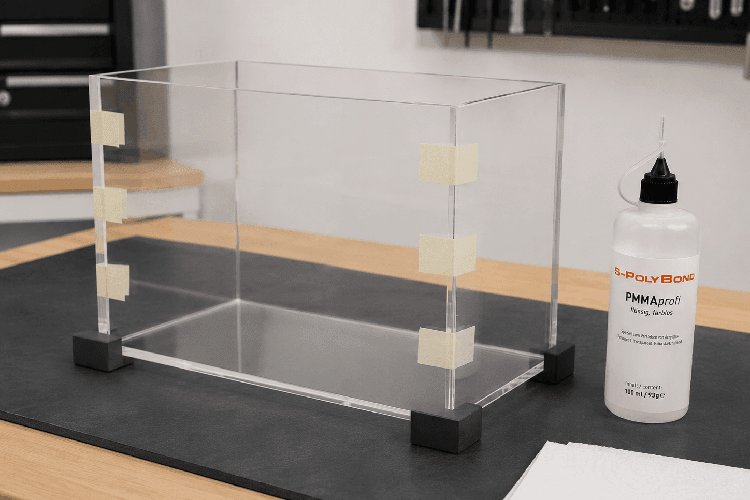
Bonding acrylic glass with S-Polybond PMMAprofi in the video
The video shows how acrylic glass is bonded by solvent welding with S-Polybond PMMAprofi. It demonstrates what matters when aligning the bonding surfaces correctly, dosing the adhesive in a controlled manner and allowing sufficient curing time.
Basic rules for clean acrylic glass bonds
- Precisely fitting components: The bonding edges must be flat and fit together exactly.
- Clean surfaces: Dust, grease, dirt and residues impair the bond.
- Stress-free fixing: The components must not be under stress while being bonded.
- Exact alignment: Check the right angles and positions before applying the adhesive.
- Controlled dosing: Low-viscosity PMMA adhesive must be applied cleanly and precisely.
- Observe the curing time: The bond must be protected from moisture and allowed to cure completely.
S-Polybond PMMAprofi has a working time of approximately 2 to 3 minutes. The fixing time is approximately 30 minutes and full curing takes approximately 24 hours. Fixing must be carried out with particular care if there are high stresses or the construction will be permanently exposed to water.
Always follow the information in the technical data sheet and safety data sheet during use. The adhesive should only be used with adequate ventilation and suitable protective measures.
Important: An adhesive alone does not automatically make an aquarium safe. The material selection, sheet thickness, precise cutting, flat bonding surfaces, stress-free fixing, complete curing and a thorough leak test are all decisive.
Safety and watertightness of a self-built acrylic glass aquarium
Before a self-built acrylic glass aquarium is used permanently, it should be tested thoroughly. The first test should be conducted without animals, plants, substrate or equipment. This allows leaks, deformation and stress to be detected early.
Place the tank on a level, load-bearing surface. Fill it with water slowly and in stages. Observe the bonded joints, corners and front panel. Particularly for larger tanks, the test should be conducted over an extended period.
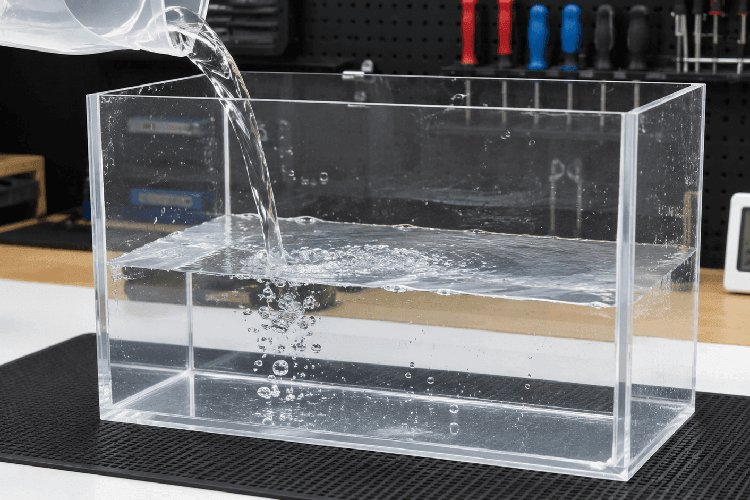
Leak test checklist
- Level surface: The tank must have full-surface support and stand without stress.
- Fill slowly: Raise the water level step by step.
- Inspect bonded joints: Observe the corners and butt joints carefully.
- Check for deformation: Inspect the front and side panels for deflection.
- Test for long enough: Do not place animals or plants in the tank immediately.
- Stop if uncertain: Remove the water and inspect the construction.
A self-built acrylic glass aquarium should still be inspected regularly after passing the test. Look for deformation, fine cracks, leaks and changes in the bonded joints. If there is any uncertainty, the tank should not remain in use.
Safety note: Depending on its size, an aquarium contains a considerable volume of water. Errors in the sheet thickness, construction or bonding can cause leaks or breakage. Include a sufficient safety margin in the design and seek professional advice for larger tanks.
Cleaning and caring for an acrylic glass aquarium
Acrylic glass is easy to maintain but more susceptible to scratches than glass. Acrylic glass surfaces should therefore always be cleaned gently. Hard sponges, scouring agents, rough cloths and aggressive cleaners are unsuitable because they can cause fine scratches or matt areas.
A suitable acrylic glass cleaner can be used on external acrylic glass surfaces and areas that do not come into contact with the aquarium water. A suitable PMMA polishing paste can be useful for fine scratches or matt external surfaces. Inside an aquarium, however, only products suitable for aquariums and which do not introduce harmful residues into the water may be used.
- Do not wipe while dry: Dust and sand can act like abrasive grains.
- Use soft cloths: Avoid hard or rough cloths.
- Do not use scouring agents: They can permanently damage the surface.
- Care for external surfaces: Material-compatible acrylic glass cleaners are suitable for external areas.
- Treat internal surfaces carefully: Use only aquarium-safe cleaning methods in areas containing water.
S-Polybond PMMAclean can be used to care for external acrylic glass surfaces, while S-Polybond PMMApolitur can be used for fine scratches on the outside. Neither product should be introduced into an occupied aquarium or applied directly to the water-filled interior.
Acrylic glass instead of glass: advantages and limitations for aquariums
Acrylic glass offers several interesting advantages for aquarium construction. It is lighter than glass, has very high light transmission and is less susceptible to breakage. This can make it attractive for individual aquariums, display tanks, terrariums, transparent containers and special shapes.
At the same time, acrylic glass also has limitations. It is more susceptible to scratches than glass and requires greater care during bonding, cleaning and construction. Anyone intending to build an acrylic glass aquarium should therefore consider not only its appearance but also its stability, care and long-term loading.
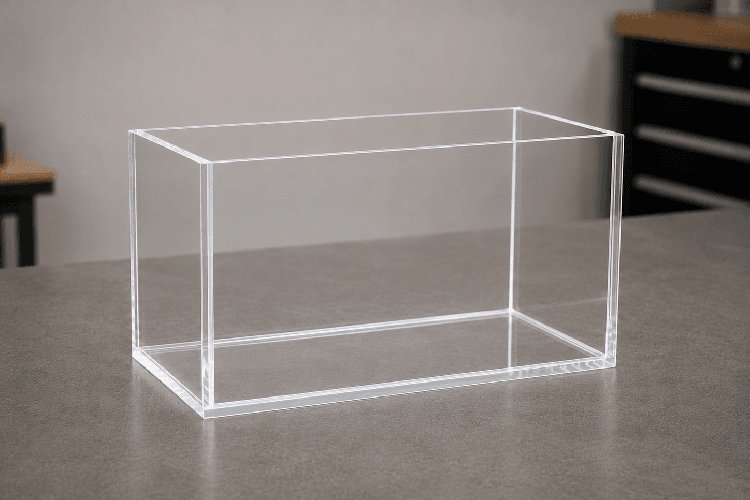
Clear appearance
Transparent acrylic glass offers a brilliant, crystal-clear appearance and high light transmission. This is ideal when a tank is intended to look modern, light and high-quality.
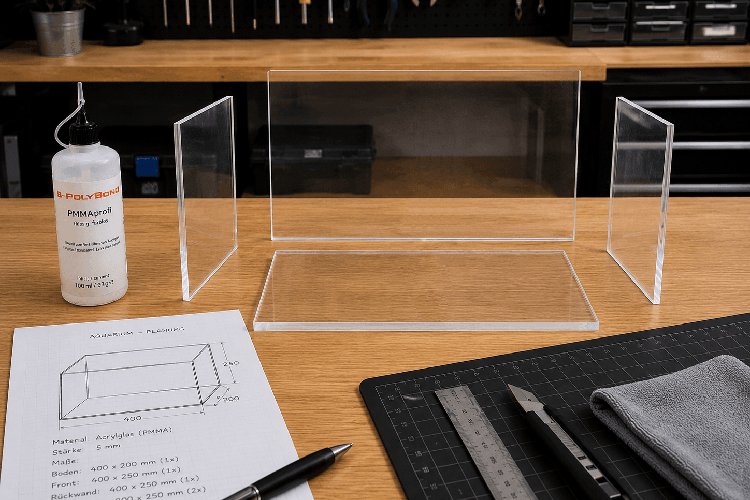
Individual planning
Using acrylic sheets cut to size, the base, front, rear, sides and cover can be planned to suit the project. Depending on the design, drill holes, cut-outs and special shapes are also possible.
You can find suitable transparent sheets for individual projects in the category acrylic sheets for individual projects. You can select acrylic glass XT or GS to suit your project.
Conclusion: build your own acrylic glass aquarium – possible with careful planning
Building your own acrylic glass aquarium is possible, but it requires careful planning. Selecting the right material, choosing a suitable sheet thickness, precise cutting, clean bonding surfaces, professional bonding and a thorough leak test are essential.
For high-quality aquarium projects, acrylic glass GS can offer advantages for precise machining and clean bonded joints due to its lower internal stress. Whether it is suitable for a particular tank must be assessed together with the dimensions, sheet thickness, construction and permanent water load. A special PMMA adhesive such as S-Polybond PMMAprofi can be used for bonding.
S-Polytec supplies suitable sheets for the base, front, rear, sides and cover as acrylic glass XT and GS cut to size. This allows you to plan your aquarium project precisely and configure the required acrylic sheets accordingly.
Frequently asked questions about acrylic glass aquariums
Can you build your own acrylic glass aquarium?
Yes, an aquarium can be built from acrylic glass. A suitable sheet thickness, precise cutting, clean bonding surfaces, professional bonding and a thorough leak test are essential. The construction of larger aquariums should be professionally designed.
Which acrylic glass is suitable for an aquarium?
Due to its lower internal stress, transparent acrylic glass GS can offer advantages for precise machining, clean edges and bonding. However, whether XT or GS is suitable depends on the tank dimensions, sheet thickness, construction, bonding and permanent water load.
What sheet thickness does an acrylic glass aquarium require?
The appropriate sheet thickness depends on the tank length, water height, design, bracing, bonding and safety margin. A universal thickness recommendation is therefore not appropriate. The thickness should be professionally determined for structures permanently exposed to water.
Can acrylic glass be bonded for an aquarium?
Yes, acrylic glass can be joined with suitable PMMA adhesives. S-Polybond PMMAprofi is a special cold-welding adhesive for acrylic glass. Precisely fitting, clean bonding surfaces, stress-free fixing and complete curing are essential.
Is acrylic glass better than glass for an aquarium?
Acrylic glass is lighter than glass, very transparent and less susceptible to breakage. At the same time, it is more prone to scratches and places high demands on cutting, bonding and care. Whether acrylic glass is more suitable therefore depends on the particular aquarium project.
Does a self-built acrylic glass aquarium need to be tested?
Yes, a self-built acrylic glass aquarium should always be tested without animals, plants or equipment before use. The tank should be filled slowly and monitored for a sufficient period for leaks, deformation and stress.
Category Anwendungstipps
- Avoid root damage by using root barriers
- Bonding acrylic glass – adhesives, preparation and instructions
- Build your own privacy screen from HPL sheets
- Buy weatherproof and waterproof panels for outdoor use
- Cladding a roof overhang with aluminium composite panels – modern, durable and easy to install