
How to use 2K adhesive correctly: Mixing, Dispensing & Application
Posted on Sep 24, 2026
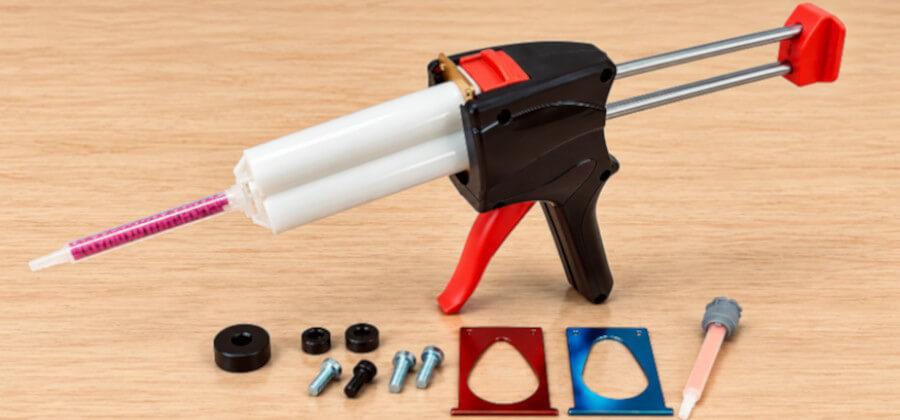
How to use 2K adhesive correctly: In this blog, we explain how two-component adhesives work and what to consider when it comes to mixing ratio, double cartridges, adhesive mixers, dispensing guns, surface preparation, adhesive application and curing.
Two-component adhesives, also known as 2K adhesives, are used when materials need to be bonded permanently and reliably. They consist of two separate components that are only combined in the specified mixing ratio immediately before the adhesive is applied.
In this blog, we show you step by step how to use a 2K adhesive correctly, how the double cartridge, adhesive mixer and dispensing gun work together, and what you need to consider regarding the mixing ratio, surface preparation, adhesive application, working time, fixing and curing.
How does a 2K adhesive work?
A 2K adhesive consists of two components that remain separate until they are applied. Only when both components are combined and mixed does the chemical reaction begin that causes the adhesive to cure.
In ready-to-use double cartridges, both components are stored in separate chambers. When the dispensing gun is operated, they are dispensed simultaneously from the cartridge and then passed through a suitable adhesive mixer. The components are mixed reliably inside the mixer before the adhesive exits the tip.
In short: The double cartridge keeps the two components separate until application. The adhesive mixer then ensures that they are mixed evenly immediately before the adhesive is applied.
Why does a 2K adhesive consist of two components?
Keeping the components separate prevents the curing reaction from starting inside the cartridge. Only after mixing is the adhesive available for a limited working time or pot life.
Does a 2K adhesive have to be mixed by hand?
With an adhesive system in a double cartridge, it is normally not necessary to measure and mix the components manually in a separate container. The cartridge is designed for the specified mixing ratio. In combination with the correct dispensing gun, both components are dispensed simultaneously and mixed together in the adhesive mixer.
What is needed to apply a 2K adhesive?
Several components must be compatible with one another in order to apply a 2K adhesive from a double cartridge correctly. It is not only the adhesive itself that matters, but also the appropriate accessories for dispensing and application.
- 2K adhesive: Suitable for the materials that are to be bonded.
- Double cartridge: Contains both components separately and is designed for the specified mixing ratio.
- Dispensing gun: Dispenses both components simultaneously from the double cartridge.
- Suitable adapter plate: Accommodates the respective cartridge shape in the dispensing gun.
- Suitable pistons: Must match the cartridge chambers and mixing ratio.
- Adhesive mixer: Mixes the two components during dispensing.
- Cleaning agent: For cleaning the bonding surfaces and removing uncured adhesive residue.
- Fixing aids: Depending on the component, for example clamps or other suitable fixing aids.
Important: Mixing ratio, double cartridge, dispensing gun, pistons and adhesive mixer must all be compatible with one another. A matching mixing ratio alone does not automatically mean that the cartridge connection or adhesive mixer will also fit.
What does the mixing ratio mean?
The mixing ratio indicates the proportions in which the two components of a 2K adhesive must be combined. Depending on the adhesive system, mixing ratios such as 1:1, 2:1, 4:1 or 10:1 may be specified.
With a ratio of 1:1, both components are dispensed in equal quantities. A ratio of 10:1, on the other hand, means that ten parts of the first component are combined with one part of the second component.
Does the mixing ratio have to be set manually?
With a suitable double cartridge, the required ratio is determined by the different dimensions of the cartridge chambers and the corresponding pistons of the dispensing gun. The components therefore do not have to be measured manually.
Do not confuse mixing ratio and mechanical leverage ratio
The mixing ratio of the adhesive is not the same as the mechanical leverage ratio of a dispensing gun. The leverage ratio describes the force transmission when the hand lever is operated. It does not indicate the ratio in which the two adhesive components are mixed.
Example: A dispensing gun may have a mechanical leverage ratio of 10:1 and still be suitable for double cartridges with different adhesive mixing ratios, provided that the adapter plate and pistons are adjusted accordingly.
How does a 2K double cartridge work?
A double cartridge consists of two separate chambers. This keeps the two adhesive components separate from one another until immediately before application.
The size of the individual chambers depends on the specified mixing ratio. With a 1:1 system, the chambers are correspondingly the same size. With a 10:1 system, one chamber is considerably larger than the other.
Why are there different cartridge connections?
In addition to the mixing ratio, double cartridges also differ in their design and the connection for the adhesive mixer. An adhesive mixer can therefore be unsuitable despite having the correct mixing ratio if its connection does not match the cartridge.
Our range includes, for example, double cartridges with MAH/MAQ bayonet connections as well as cartridges with B-System connections.
Important: Always check the mixing ratio and connection system of the double cartridge before application.
Which adhesive mixer is required?
The adhesive mixer, also frequently referred to as a mixing nozzle or static mixer, brings the separate components together and mixes them during dispensing. Inside the mixer are fixed mixing elements through which the material is guided and repeatedly mixed. In this blog, we mainly use the term adhesive mixer in line with our product descriptions.
The adhesive mixer required depends primarily on the connection of the double cartridge and the respective mixing ratio.
MAH/MAQ adhesive mixer
Double cartridges with an MAH/MAQ bayonet require a corresponding adhesive mixer with MAH/MAQ bayonet. Depending on the cartridge, this connection system can be used with different mixing ratios.
MBQ adhesive mixer for the B-System
Double cartridges with a B-System connection require a mixer designed for this system. Our MBQ adhesive mixer for the B-System has separate material inlets. The components therefore only come into contact with one another inside the adhesive mixer.
Can an adhesive mixer be used more than once?
As soon as the two components are mixed together inside the adhesive mixer, the adhesive reaction begins. The material remaining in the mixer reacts and subsequently cures.
An adhesive mixer in which the mixed adhesive has already reacted or cured cannot be reused. If a resealable cartridge is used again at a later date, a new adhesive mixer is therefore fitted.
Remember: The adhesive cartridge can be reused later with systems designed for resealing. An adhesive mixer containing cured adhesive cannot.
Preparing a 2K dispensing gun correctly
The dispensing gun is used to dispense both components evenly from the double cartridge. For this to work correctly, the adapter plate and pistons must match the cartridge being used.
Our 2K dispensing gun for double cartridges up to 50 ml can be adapted to different cartridge shapes and mixing ratios using different adapter plates and interchangeable pistons.
| Adapter plate | Cartridge shape / ratio | Pistons |
|---|---|---|
| Yellow | Square flange / 1:1 | 2 × Ø 13 mm |
| Blue | Round flange / 2:1 | Ø 19 mm + Ø 13 mm |
| Red | Round flange / including 10:1 | For our 10:1 systems Ø 24 mm + Ø 7 mm |
Inserting the double cartridge
Pull the feed rod fully back. Then pull the adapter plate upwards and fold it forwards. The double cartridge can now be inserted and the adapter plate returned to its intended position.
Changing the adapter plate and pistons
If a different cartridge shape or mixing ratio is used, the adapter plate and pistons may need to be changed. The pistons must always match the two chambers of the double cartridge being used.
Tip: To change the pistons, the feed rod can be pushed fully forwards. The pistons are tightened hand-tight.
Preparing surfaces for bonding
A reliable adhesive bond begins with clean joining surfaces that are suitable for the adhesive being used. Dust, grease, oil, release agents and other contaminants can impair adhesion.
Cleaning the bonding surfaces
The surfaces must be clean and dry before joining. Use a cleaner that is suitable for the respective material and adhesive.
Is sanding always required?
This depends on the adhesive system being used. For certain adhesives, the application instructions specify light sanding of the surfaces. Other systems have different requirements for surface preparation or the use of a primer.
The application instructions for the adhesive being used should therefore always be followed.
Important: Surface preparation, alignment of the components and the required fixing aids should be completed before the two components are combined in the adhesive mixer.
How to apply 2K adhesive step by step
When applying a 2K adhesive from a double cartridge, following a clear sequence is particularly important. As soon as the two components are mixed together, only the respective working time or pot life remains available.
1
Select the correct adhesive
First check which materials are to be bonded and whether the selected 2K adhesive is suitable for this material combination and the intended application.
2
Check the mixing ratio and cartridge
Check the specified mixing ratio as well as the design and connection of the double cartridge. The adhesive can only be dispensed and applied correctly if the cartridge and accessories are compatible.
3
Prepare the dispensing gun
Fit the appropriate adapter plate and the pistons belonging to the cartridge system into the dispensing gun. Then check that all components have been inserted correctly and are securely seated.
4
Prepare the joining surfaces
Clean and dry the intended bonding surfaces in accordance with the adhesive specifications. If required, additional steps such as sanding or primer treatment are carried out.
5
Insert the adhesive cartridge
Pull the feed rod of the dispensing gun fully back and insert the double cartridge. Then return the adapter plate to its intended position.
6
Open the adhesive cartridge
Carefully remove the intended closure from the double cartridge. Make sure that the cartridge is not yet under pressure and that no material can escape uncontrollably.
7
Check material flow
If specified in the application instructions, dispense a small amount of both components onto a test piece. Check that both materials flow freely and evenly from the cartridge.
8
Fit a new adhesive mixer
Fit a new adhesive mixer that matches both the connection of the double cartridge and the specified mixing ratio of the 2K adhesive being used.
9
Dispense a small amount of adhesive
After fitting the adhesive mixer, first dispense a small amount of adhesive. Follow the application instructions for the respective adhesive system and check the material flow.
10
Apply the adhesive
Apply the mixed adhesive evenly and in sufficient quantity to the intended bonding surface. When the components are joined, the intended areas should be fully wetted.
11
Join the components
Join the prepared components within the specified working time or pot life. Then carefully align both components in the intended position.
12
Fix the components in position
Secure the joined components reliably against movement or slipping. The fixing remains in place until the specified fixing time or handling strength of the adhesive has been reached.
13
Remove excess adhesive
Remove excess adhesive from adjacent areas wherever possible before it has fully cured. Reacted or cured material is considerably more difficult to remove later.
Practical tip: Fully prepare the bonding surfaces, dispensing gun, adhesive mixer and fixing aids before the two components are mixed together.
Working time, fixing time and curing
Different time specifications are used for 2K adhesives. Which terms and times apply depends on the particular adhesive.
Working time or open time
The working time refers to the period during which the mixed adhesive can be applied. The adhesive must be applied and the components joined or positioned within this time window.
Pot life
For other adhesive systems, the term pot life is used. It describes the period between combining and mixing the components and the point at which the adhesive can no longer be used.
Handling strength or fixing time
The fixing time describes the period during which the components must remain stationary in their intended position after joining. Some technical data sheets also use the term handling strength.
Final strength and complete curing
A bond may already have reached handling strength even though the adhesive has not yet achieved its final properties. The fixing time must therefore not automatically be equated with complete curing or final strength.
What influence does temperature have?
The stated working, fixing and curing times apply under the conditions specified in the respective technical data sheet. Depending on the adhesive system, the ambient temperature can influence the reaction and therefore also the fixing time. Time specifications should therefore always be considered together with the specified application temperatures of the adhesive being used.
Important: Working, fixing and curing times are product-specific and may additionally be influenced by temperature, adhesive gap and other application conditions.
Taking the adhesive gap into account
With an adhesive joint, the components should not automatically be pressed completely together using the highest possible pressure. Depending on the adhesive system, specifications may apply to the adhesive layer or permissible adhesive gap.
Gap-filling 2K adhesives can compensate for unevenness or distances between the joining surfaces within their product-specific limits.
What does gap-filling capability mean?
Gap-filling capability indicates the range within which an adhesive can bridge a distance between the joining surfaces.
Important: The permissible gap-filling capability is product-specific. Adhesive layer thicknesses stated for individual test methods must not automatically be interpreted as a generally permissible adhesive gap.
Reusing an opened 2K cartridge
Many double cartridges do not have to be completely used during a single application. As long as the two components remain separate inside the cartridge and the adhesive system is designed to be resealed, the remaining material can be used again later.
Remove the used adhesive mixer
After application, remove the used adhesive mixer from the cartridge. Any adhesive that has already been mixed inside the mixer will react and subsequently cure.
Reseal the cartridge
Close the double cartridge using the intended closure and store it in accordance with the product-specific requirements.
Use a new adhesive mixer for the next application
If the cartridge is used again later, fit a new adhesive mixer that is compatible with the cartridge system.
Remember: A resealable adhesive cartridge can be used again later. An adhesive mixer containing adhesive that has already reacted or cured must be replaced.
Removing adhesive residue and cleaning
Adhesive residue is generally easier to remove while the adhesive has not yet fully cured. Joining surfaces and tools should therefore be cleaned as soon as possible after application if necessary.
The cleaner that may be used depends on the adhesive and material in question. Aggressive or unsuitable solvents can attack plastics or adversely affect the curing process.
Depending on the system, cured 2K adhesive may only be removable mechanically.
Tip: Always follow the cleaning instructions for the adhesive being used and check that the cleaner is compatible with the material.
Storing 2K adhesive correctly
Two-component adhesives also differ in terms of storage requirements. Storage temperature and storage period can influence shelf life and subsequent application.
The cartridges should be kept sealed in accordance with the product-specific requirements, protected from unsuitable temperatures and used within the stated shelf life.
Important: The information in the technical data sheet for the respective adhesive is always decisive for storage temperature and shelf life.
Common mistakes when applying 2K adhesive
- Selecting an unsuitable adhesive: The adhesive must match the material and the expected loads.
- Not checking the mixing ratio: Double cartridge, pistons and accessories must be compatible.
- Using the wrong adhesive mixer: Mixer, mixing ratio and connection must be compatible.
- Confusing mixing and leverage ratios: The two values describe different properties.
- Using an unsuitable adapter plate: The adapter plate must match the double cartridge.
- Fitting the wrong pistons: The pistons must match the cartridge chambers.
- Insufficient surface preparation: Dust, grease and oil impair the bond.
- Reusing an adhesive mixer: A new adhesive mixer is required for subsequent application.
- Exceeding the working time: The adhesive must be applied within the specified time window.
- Moving the components during fixing: Movement can impair the adhesive bond.
- Loading the joint too early: Fixing time does not automatically mean final strength.
- Applying excessive pressure: Too much pressure can force adhesive out of the joint.
Which 2K adhesive is suitable for which material?
The 2K adhesive to use depends primarily on the materials that are to be bonded. Appropriately matched adhesive systems are available for different plastics and material combinations.
For a detailed overview of adhesive selection by plastic type, see our blog Which adhesive for plastic?.
| Material / application | Example from our range | Mixing ratio |
|---|---|---|
| Polyethylene, especially PE-HD, PE500 and PE1000 | S-Polybond PEprofi | 10 adhesive : 1 activator |
| Polypropylene, especially PP-H and PP-C | S-Polybond PPprofi | 10 adhesive : 1 activator |
| Suitable plastics, metals and composite materials for structural bonding | S-Polybond 2K MMAprofi | 1:1 |
| Suitable thermoplastics, metals and composite materials with a short pot life | Plexus MA300™ | 1:1 |
| Suitable thermoplastics, metals and composite materials with a longer pot life | Plexus MA310™ | 1:1 |
Take different working times into account
In addition to material compatibility, the available working time can also be important when selecting an adhesive. An adhesive with a short pot life is suitable, for example, for applications in which the components can be joined quickly. For larger components or components that require more complex alignment, a longer pot life can provide more time for positioning and fixing.
As specific examples, Plexus MA300™ has a pot life of 3 to 6 minutes and a fixing time of 12 to 15 minutes at +23 °C. For Plexus MA310™, these values are 15 to 18 minutes and 45 to 55 minutes respectively.
PEprofi and PPprofi have a working or open time of approximately 3 minutes. Handling strength or fixing time at +25 °C is approximately 90 to 250 minutes, while final strength is reached after approximately 8 to 24 hours.
Safety and handling
Two-component adhesives differ in their chemical composition. The current safety data sheets for the individual components must therefore be read and followed before use.
- Avoid skin and eye contact: Follow the product-specific protective measures.
- Wear suitable protective equipment: Use personal protective equipment in accordance with the safety data sheets.
- Ensure adequate ventilation: Observe the instructions regarding ventilation or extraction.
- Do not eat, drink or smoke: Follow the product-specific hygiene instructions during application.
- Avoid ignition sources: For appropriately classified products, observe the fire and explosion protection instructions.
- Store the adhesive correctly: Observe the storage conditions in the technical data sheet and safety data sheet.
Important: The information in this blog does not replace the technical data sheets and safety data sheets for the adhesive being used. These must be observed before application.
How to use 2K adhesive correctly: the most important points at a glance
With a 2K adhesive, it is not only the two adhesive components that need to be compatible. The double cartridge, mixing ratio, dispensing gun, adapter plate, pistons and adhesive mixer must also be matched to one another.
For a reliable bond, the bonding surfaces should be fully prepared before the adhesive is mixed. The components are then dispensed in the correct ratio, mixed in the adhesive mixer and applied within the specified working time or pot life.
After joining, the components must remain stationary until the specified fixing time or handling strength has been reached. An opened adhesive cartridge designed for resealing can be closed again after use and subsequently reused with a new adhesive mixer.
Which 2K adhesive is ultimately suitable depends on the material, application and subsequent load. Suitable adhesives, adhesive mixers and accessories for application can be found in our online shop.
Frequently asked questions about 2K adhesives
What is a 2K adhesive?
A 2K adhesive consists of two separate components that are only mixed together immediately before application. Once mixed, the chemical reaction and therefore the curing of the adhesive begins.
How does a 2K double cartridge work?
A double cartridge has two separate chambers for the two adhesive components. When the appropriate dispensing gun is operated, both components are dispensed simultaneously and then mixed together inside the adhesive mixer.
Does 2K adhesive have to be mixed by hand?
With a 2K adhesive in a suitable double cartridge, the components do not have to be measured by hand. Dispensing is controlled by the cartridge and the matching pistons of the dispensing gun. The two components are then mixed inside the adhesive mixer.
What does the mixing ratio of a 2K adhesive mean?
The mixing ratio indicates the proportions in which the two components are combined. With 1:1, both components are dispensed in equal quantities. With 10:1, ten parts of the first component are combined with one part of the second component.
Which adhesive mixer is required for a 2K adhesive?
The adhesive mixer must match the connection of the double cartridge and the specified mixing ratio. The mixing ratio alone is not sufficient to select the correct mixer.
Can an adhesive mixer be used more than once?
An adhesive mixer in which the mixed adhesive has already reacted or cured cannot be reused. If a resealable cartridge is used again later, a new compatible adhesive mixer is fitted.
What is the difference between working time and fixing time?
The working time describes the period during which the mixed adhesive can be applied. The fixing time, on the other hand, describes the period during which the joined components must remain stationary.
How long does 2K adhesive take to dry or cure?
For 2K adhesives, the technical term is curing. The time required for the adhesive to reach complete cure or final strength depends on the respective adhesive system and application conditions. Fixing time must not be equated with complete curing.
Can an opened 2K cartridge be reused?
If the adhesive system is designed to be resealed, the double cartridge can be closed again after use and reused later. A new adhesive mixer is required for the next application.
Which 2K adhesive is suitable for PE or PP?
Specially developed adhesive systems should be used for low-energy plastics such as polyethylene and polypropylene. Our range includes S-Polybond PEprofi for polyethylene and S-Polybond PPprofi for polypropylene.