
Which adhesive for plastic? The complete guide to choosing the right one
Posted on Apr 15, 2026
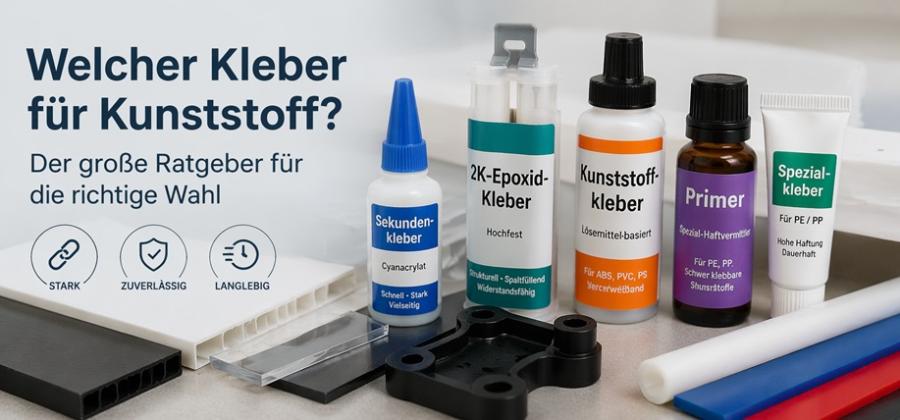
Which adhesive is suitable for plastic depends primarily on the material being used. Not all plastics are the same: while PVC, ABS or acrylic glass can usually be bonded very well, PE, PP or PTFE require special adhesives, adhesion promoters or alternative joining techniques.
Which adhesive is suitable for which plastic? This depends mainly on the specific material, its surface structure and the required joint. Plastics such as ABS, PVC or PMMA can be bonded comparatively well, whereas PE, PP or POM require specially matched adhesive systems.
In this blog, you will find a quick selection guide for the most important plastics. The table shows at a glance how well each material can be bonded, which special characteristics must be considered and which adhesives are suitable.
Which adhesive is suitable for which plastic
The following overview provides quick guidance. In addition to the plastic itself, the joint width, mating material, load and required flexibility of the bond are also decisive.
| Plastic | Bondability | Recommended adhesives | Important to know |
|---|---|---|---|
| ABS | Good |
ABSProfi Ruderer L530 Plexus MA 300 | Close-fitting surfaces can be solvent-bonded. Choose other systems for gaps or combinations with metal. |
| ASA | Good |
ABSProfi Ruderer L530 Plexus MA 300 | Can be bonded similarly to ABS. Two-component systems may be suitable for load-bearing bonds and combinations with metal. |
| PVC | Good |
PVCProfi Assembly adhesive 2C adhesive | PVC to PVC can be solvent-bonded effectively. Use other systems for metal or mineral substrates. |
| PMMA / Acrylic glass | Good |
PMMAProfi AX Plastics T Plexus MA 300 | Susceptible to stress cracking. Clean, low-stress processing is particularly important. |
| Polycarbonate / PC | Limited | AX Plastics T | Sensitive to many solvents. Ensure low-stress processing. |
| Polystyrene / PS | Good | Solvent adhesive | Can be solvent-bonded. Apply the adhesive in a controlled manner. |
| PA / Polyamide | Difficult | Special 2C adhesive systems | Semi-crystalline plastic; solvent bonding is not suitable. |
| POM | Very difficult | Special adhesive with pre-treatment | Very low surface energy. Mechanical connections are often the more practical solution. |
| PE | Difficult | PEProfi | Low surface energy. Special adhesive systems are required. |
| PP | Difficult |
Superglue PPProfi | Superglue may be sufficient for small contact areas; durable bonds require special systems. |
| EPDM | Limited | Superglue | A flexible bond is required. Use flexible adhesive systems for larger or dynamic bonds. |
| PTFE | Very difficult | – | Reliable bonding is practically impossible with conventional adhesive systems. |
| PET / PETG | Limited | Reactive 2C adhesive systems | Not suitable for conventional solvent bonding. A clean surface is required. |
| GRP / CFRP | Good |
2C MMA adhesive Assembly adhesive | The bond is formed through the resin matrix. Clean and properly prepared surfaces are important. |
| HPL | Good | Assembly adhesive | Well suited to surface bonding. Prepare the surface accordingly. |
| TPU / TPE | Limited | Superglue | The flexibility of the adhesive must match the movement of the material. |
Guidance: “Easy to bond” does not mean that every adhesive is suitable. The specific adhesive system must always match the plastic, mating material and load.
Plastics that are easy to bond
Amorphous plastics such as ABS, ASA, PVC, PMMA and polystyrene can often be bonded comparatively well. With some of these materials, suitable solvent-based adhesives can slightly dissolve the surface and thereby create a particularly close bond.
- ABS: ABSProfi for close-fitting joints, Ruderer L530 for smaller gaps.
- ASA: Bonding similar to ABS; two-component systems may be useful for higher loads.
- PVC: PVCProfi is particularly suitable for PVC-to-PVC joints.
- PMMA: PMMAProfi for close-fitting acrylic-glass joints with low-stress processing.
- Polystyrene: Suitable solvent adhesives enable strong bonds.
Important for PMMA: Acrylic glass is susceptible to stress cracking. Alcohols and unsuitable solvents can be problematic. Further information on adhesive selection, fixing and curing can be found in the blog Bonding acrylic glass correctly.
Plastics that are difficult to bond
Semi-crystalline plastics and materials with low surface energy place significantly higher demands on bonding. Conventional universal adhesives are often insufficient here.
| Material | Challenge | Solution |
|---|---|---|
| PE | Very low surface energy | Special adhesive such as PEProfi |
| PP | Low surface energy | PPProfi or a suitable superglue for small areas |
| PA | Semi-crystalline structure | Special 2C adhesive systems |
| POM | Very low surface energy | Special system and suitable pre-treatment |
| PTFE | Extremely low adhesion | Bonding with conventional systems is usually not practical |
PE and PP: Specially developed adhesive systems are available for low-energy plastics and are significantly more reliable than conventional universal adhesives.
Bonding elastomers and composite materials
In addition to conventional thermoplastics, elastic and fibre-reinforced materials also place special demands on adhesive selection.
- EPDM: Choose flexible adhesive systems so that movement of the elastomer can be accommodated.
- TPU and TPE: The adhesive should match the high flexibility of the material.
- GRP and CFRP: Structural 2C systems are suitable for highly loaded joints.
- HPL: Surface bonding is possible with suitable assembly or contact adhesives.
- PET and PETG: Reactive adhesive systems are suitable for durable bonds.
What should you consider when choosing an adhesive?
The type of plastic is only the first step in selecting the right adhesive. Other factors must also be considered to achieve a reliable bond.
- Material combination: Plastic-to-plastic bonding has different requirements from plastic-to-metal or plastic-to-concrete.
- Fit: Very thin adhesive joints require different systems from larger gaps.
- Load: Static, dynamic and structural bonds differ considerably.
- Flexibility: Elastic materials require an adhesive that can accommodate movement.
- Surface energy: PE, PP, POM and PTFE are significantly more difficult to wet than many amorphous plastics.
- Surface preparation: Clean and suitable bonding surfaces are essential for a reliable joint.
If in doubt: Especially with difficult-to-bond plastics, unknown material combinations or highly loaded joints, the adhesive system should be selected specifically for the application.
An overview of suitable products can be found in our Adhesives for plastics category.
Frequently asked questions about bonding plastics
Which adhesive is suitable for plastic?
It depends on the plastic. ABS, PVC, PMMA or polystyrene can be bonded comparatively well with suitable plastic adhesives. PE, PP, POM or PTFE, on the other hand, require specially matched systems.
Which plastics are particularly easy to bond?
Plastics that are comparatively easy to bond include ABS, ASA, PVC, PMMA and polystyrene. The specific adhesive must still be matched to the material and application.
Why are PE and PP difficult to bond?
PE and PP have very low surface energy. Conventional adhesives therefore wet the surface poorly. Specially developed adhesive systems are more suitable for durable bonds.
Can polyethylene be bonded without a primer?
Specially developed adhesive systems such as PEProfi can also bond polyethylene grades without separate primer treatment. The relevant processing instructions for the adhesive must be observed.
Which adhesive is suitable for acrylic glass?
PMMAProfi, for example, is suitable for close-fitting acrylic-glass joints. Other adhesive or sealant systems may be required for gaps or combinations with other materials.
Can plastic be bonded to metal?
Yes, with suitable material combinations and an adhesive designed for them. Structural two-component adhesives are used, for example, for load-bearing bonds between certain plastics and metals.
Can PTFE be bonded?
PTFE has extremely low surface energy and can hardly be bonded reliably with conventional adhesive systems. Mechanical joining methods are therefore more practical in many applications.